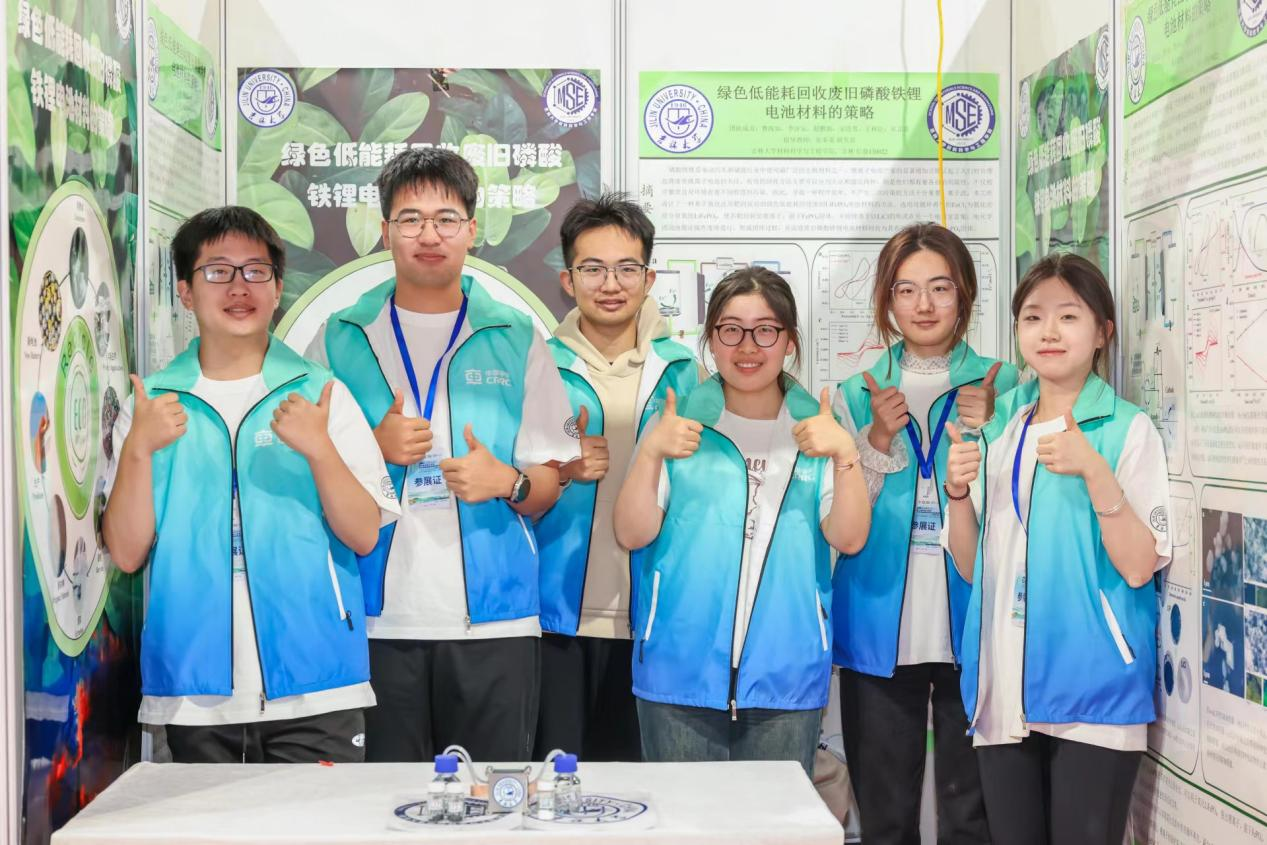
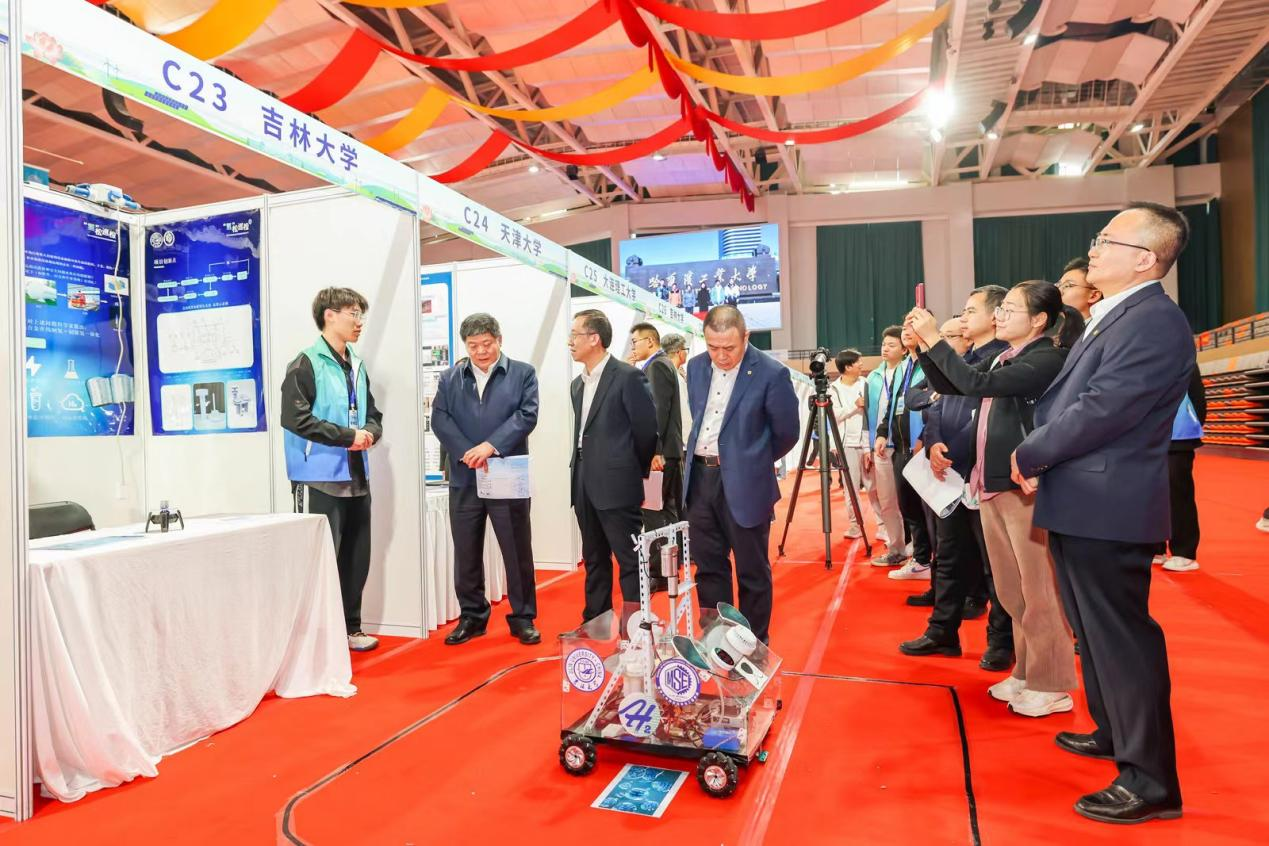
Recently, the national finals of the 6th National University Students’ Excellent Scientific and Technological Works Competition concluded at Xiamen University. The project Green and Low-Energy Recycling of Spent Lithium Iron Phosphate Battery Materials instructed by Zhang Feifei from the School won the First Prize, and the project Hydrogen-Friendly Inspection Robot: Hydrogen-Powered Vehicle with In-situ Hydrogen Generation Based on Al-Ga Based Alloys guided by Gao Qian was awarded the Second Prize.
Project 1: Green and Low-Energy Recycling of Spent Lithium Iron Phosphate Battery Materials
With large quantities of retired lithium-ion batteries being scrapped, the proper disposal of hazardous waste and low-cost recovery of valuable materials have become an urgent issue attracting widespread global attention. Improper treatment will release toxic chemicals such as heavy metals and corrosive electrolytes, posing severe threats to the environment. Pyrometallurgy and hydrometallurgy are two traditional recycling technologies widely applied in industrial mass production, yet both have obvious limitations. It is therefore critical to develop eco-friendly recycling methods with low resource consumption and zero secondary pollution.
The project team supervised by Zhang Feifei consists of three postgraduate students (Cao Hairu, Li Ji’an, Zhao Yaqi) and three undergraduates (Song Haonan, Wang Zichen, Mu Zhixuan) from the School. The team developed a low-energy recycling method for spent lithium iron phosphate batteries. Equipped with a flow battery device, this technology enables rapid lithium ion extraction from waste battery materials and sustainable regeneration of high-purity lithium salts.
This approach realizes low-cost and large-scale recovery of high-value components from waste lithium iron phosphate batteries, while overcoming the drawbacks of conventional recycling routes including high energy consumption and secondary pollution, thus boasting broad application prospects. This project was awarded the First Prize in the national finals.
Project 2: Hydrogen-Friendly Inspection Robot: Hydrogen-Powered Vehicle with In-situ Hydrogen Generation Based on Al-Ga Based Alloys
This undergraduate project team under the supervision of Professor Gao Qian includes eight undergraduates from various schools: Zhang Sheng, Li Yifan, Deng Guang, Zhang Ziniu, Zhu Zihao, He Jiabo, Dong Yiyan and Yu Qinglin. The project adopts Al-Ga based alloys for hydrogen production through hydrolysis. By matching an aluminum-based on-site hydrogen generation system with fuel cells, a compact hydrogen power system tailored for the alloy material is designed and applied to intelligent inspection vehicles.
The vehicle adopts a modular structure, and its power module serves as the core innovation of the project. Integrated Al-Ga alloy hydrogen generation and storage technology is adopted, together with a self-designed automatic continuous hydrolysis hydrogen supply system. By adjusting the feeding rates of Al-Ga alloy and water, the reaction rate can be regulated to meet the operating demands of fuel cells and output stable electric power.
Hydrogen generated from the reaction between aluminum-based materials and water effectively solves key problems of mobile equipment, such as difficult hydrogen storage, limited capacity and high risks of miniaturized hydrogen storage devices. Compared with traditional lithium batteries, this power module requires no charging and produces zero pollution, expanding the application scope of hydrogen energy. In addition, the vehicle can be fitted with multiple functional modules, applicable to food delivery, patrol inspection, field rescue and other scenarios, with promising market potential.
The National University Students’ Excellent Scientific and Technological Works Competition on Renewable Energy is a nationwide extracurricular science and technology competition guided by innovation, sponsored by the Chinese Society for Renewable Energy. First held in 2018, it runs annually and has been successfully held for six sessions. This year’s competition drew over 15,000 students from 2,624 teams across 326 universities nationwide, receiving 1,953 entries in total.
Adhering to the educational philosophy of simultaneously improving students’ scientific literacy and engineering capabilities, the School of Materials Science and Engineering will continue to fully organize and supervise student participation in various academic competitions in the future.