Recently, the research team led by Professor Zhang Lijun from the College of Materials Science and Engineering, Jilin University was invited to publish a review and outlook paper. This work systematically elaborates the vital applications and development landscape of artificial intelligence and machine learning-based data-driven strategies in semiconductor material discovery and performance optimization of electronic and optoelectronic devices. The corresponding review article, entitled Designing semiconductor materials and devices in the post-Moore era by tackling computational challenges with data-driven strategies, was published online on May 23, 2024 in Nature Computational Science, 4, 322–333 (2024).
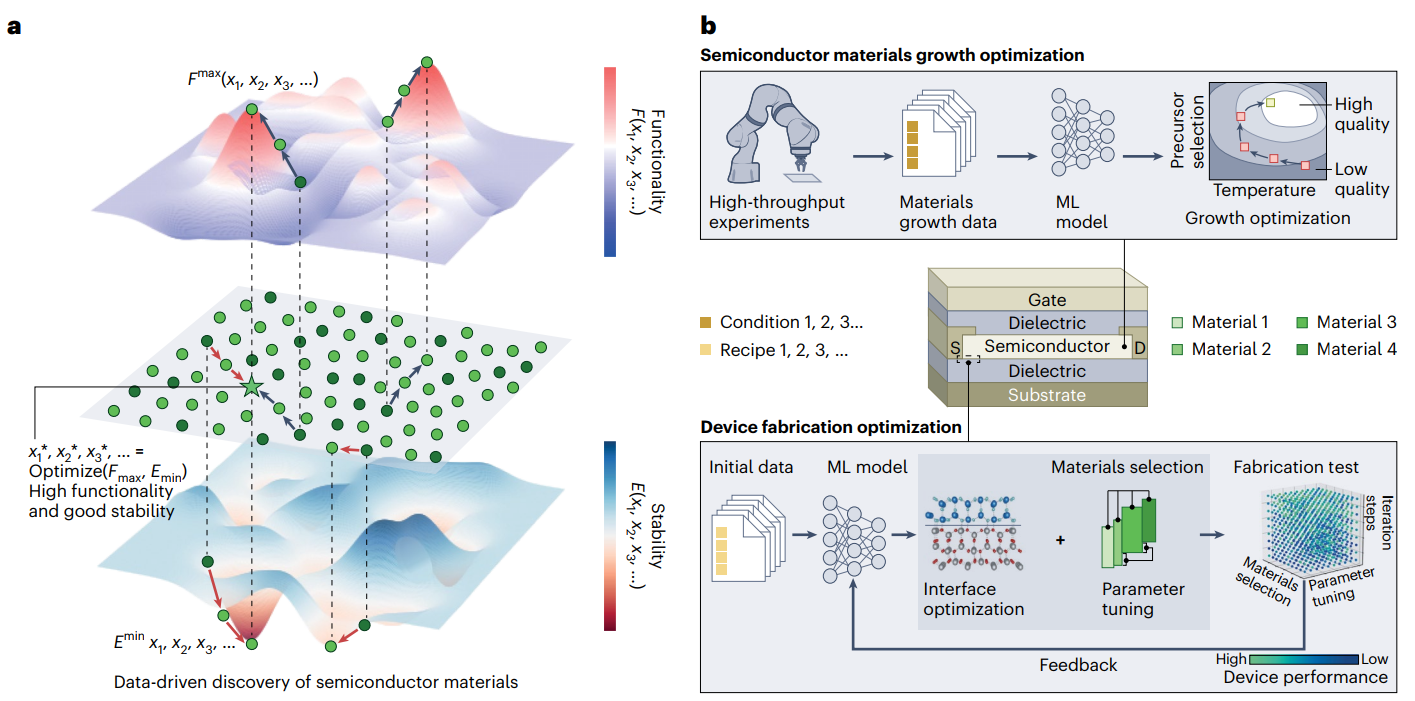
At present, designing semiconductor materials with superior physical properties is critical for continuous performance improvement of electronic devices in the post-Moore era. Quantum-mechanics-based first-principles calculations have achieved remarkable progress in interpreting experimental observations and designing new materials. Nevertheless, restricted by computational complexity and high computing cost, the efficiency of traditional material development fails to meet the urgent demand for discovering novel high-performance semiconductors in the post-Moore era. Data-driven strategies built upon artificial intelligence and machine learning provide a viable solution for developing new semiconductors and optimizing electronic device performance in the post-Moore era (Figure 1).
Figure 1. Applications of data-driven strategies in semiconductor material discovery, material synthesis and fabrication, as well as electronic device performance optimization.
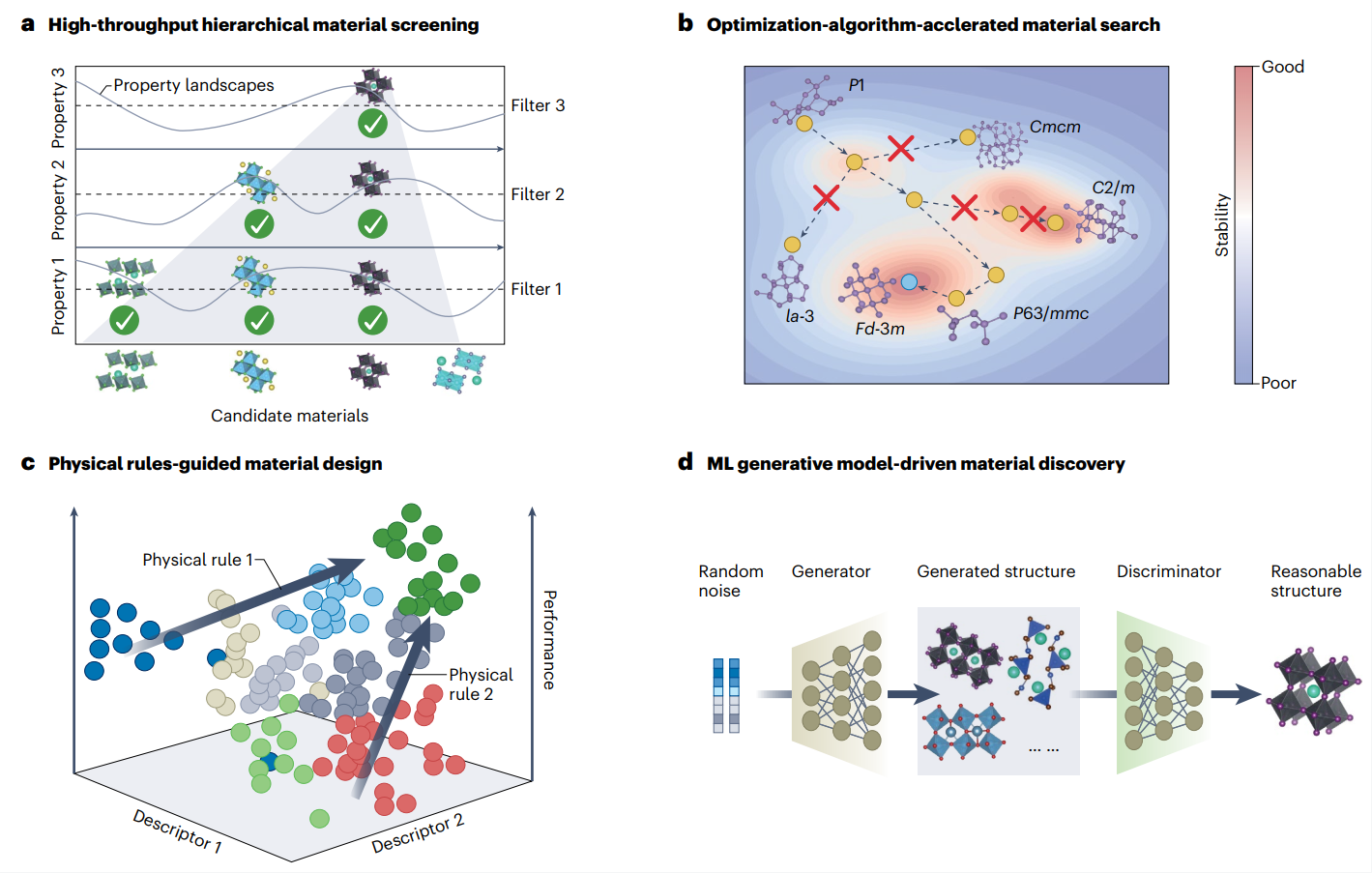
This review focuses on four mainstream categories of data-driven material development workflows. Starting from fundamental theoretical principles and extending to representative research cases, it illustrates how intelligent design and targeted optimization of high-performance semiconductors can be realized via efficient exploration of the material design space. As illustrated in Figure 2, the four material exploration paradigms include: (1) Material screening based on combinatorial uniform sampling and hierarchical filtering; (2) Global optimization search algorithms to locate extrema on material potential energy surfaces or property surfaces; (3) Physicochemical principle-guided material design strategies; (4) Generative model-based novel material generation approaches.
For each paradigm, diverse data-driven tools tightly integrated with machine learning algorithms play indispensable roles, such as material property prediction models, knowledge extraction frameworks and material generative networks.
Figure 2. Four categories of data-driven exploration workflows for material design spaces.
The paper further discusses data-augmented computational frameworks for evaluating intrinsic physical properties of semiconductors, as well as standardized pipelines for device performance optimization empowered by data-driven approaches. It highlights machine learning-enhanced electronic structure methods, potential functions and property prediction tools for simulating thermal transport, electrical transport and optical characteristics of semiconductors, together with experimental parameter prediction models (including open-loop and closed-loop optimization frameworks) for device performance tuning. In the final section, the review summarizes the prevailing challenges faced by data-driven strategies in semiconductor discovery, electronic performance enhancement and device design & manufacturing, and discusses prospective countermeasures.
Xie Jiahao, a doctoral candidate at Jilin University, is the first author, and doctoral student Zhou Yansong serves as the co-first author. Dr. Wang Xinjiang, a Dingxin Postdoctoral Fellow, and Professor Zhang Lijun from Jilin University are the corresponding authors of this paper. This research was supported by the National Key Research and Development Program of China, the National Science Fund for Distinguished Young Scholars, and the Key Joint Fund Program of the National Natural Science Foundation of China.