Recently, the Low-Dimensional Materials Research Group from the College of Materials Science and Engineering, Jilin University has achieved new research progress on transition metal-based composite materials for aqueous supercapacitors and batteries. The relevant research paper, entitled Bi-interlayer Strategy for Modulating NiCoP-based Heterostructure towards High-performance Aqueous Energy Storage Devices, was published in Advanced Materials.
The rational design and fabrication of hierarchical electrode materials constitute the key to realizing high-performance aqueous electrochemical energy storage devices (supercapatteries / zinc-ion batteries). Nickel-cobalt phosphides (NCPs) exhibit outstanding electrochemical activity and are regarded as promising candidate electrode materials for aqueous energy storage systems. Nevertheless, their practical specific capacity and rate capability still require substantial improvement. Heterostructure engineering serves as an effective route to optimize the electrochemical performance of NCPs. For advanced practical applications, it is essential to accelerate electron and ion transport kinetics of NCPs via composite selection and heterostructure design. In addition, uniform loading of active NCP species on electrodes greatly facilitates ion migration from electrolyte to electrode surface and boosts the kinetics of subsequent electrochemical reactions. Therefore, there is an urgent demand for synthetic methodologies that can simultaneously construct well-defined heterostructures and regulate the deposition behavior of NCPs.
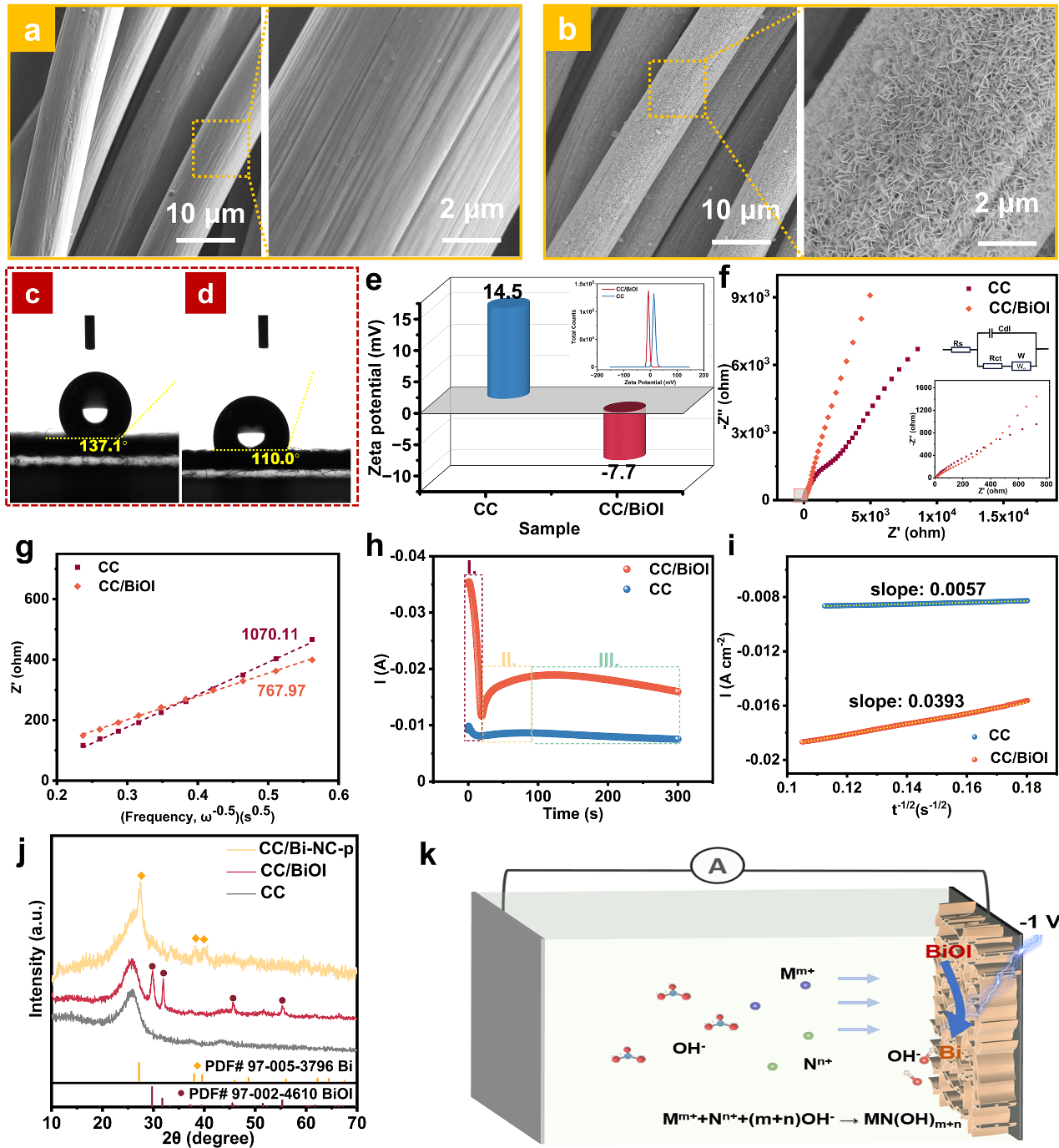
In this work, a novel bismuth (Bi) interlayer is designed and fabricated. The Bi interlayer modulates the surface chemical state of carbon cloth (CC) and tunes the electrodeposition kinetics of subsequent active materials, enabling uniform, continuous and high-mass-loading growth of active species on the current collector for efficient charge and ion transport.
Figure 1. (a) SEM image of pristine carbon cloth (CC); (b) SEM image of CC/BiOI. Contact angle measurements of (c) CC and (d) CC/BiOI. (e) Zeta potential of CC and CC/BiOI. (f) Nyquist plots; (g) real impedance (Z′) versus reciprocal square root of frequency (ω⁻⁰·⁵) in the medium-frequency region. (h) i–t curves recorded during electrodeposition of nickel-cobalt hydroxide precursors (NC-p); (i) current density versus t⁻¹/² profiles. (j) XRD patterns of CC/BiOI before electrodeposition and CC/Bi-NC-p after electrodeposition. (k) Schematic illustration of NC-p electrodeposition.
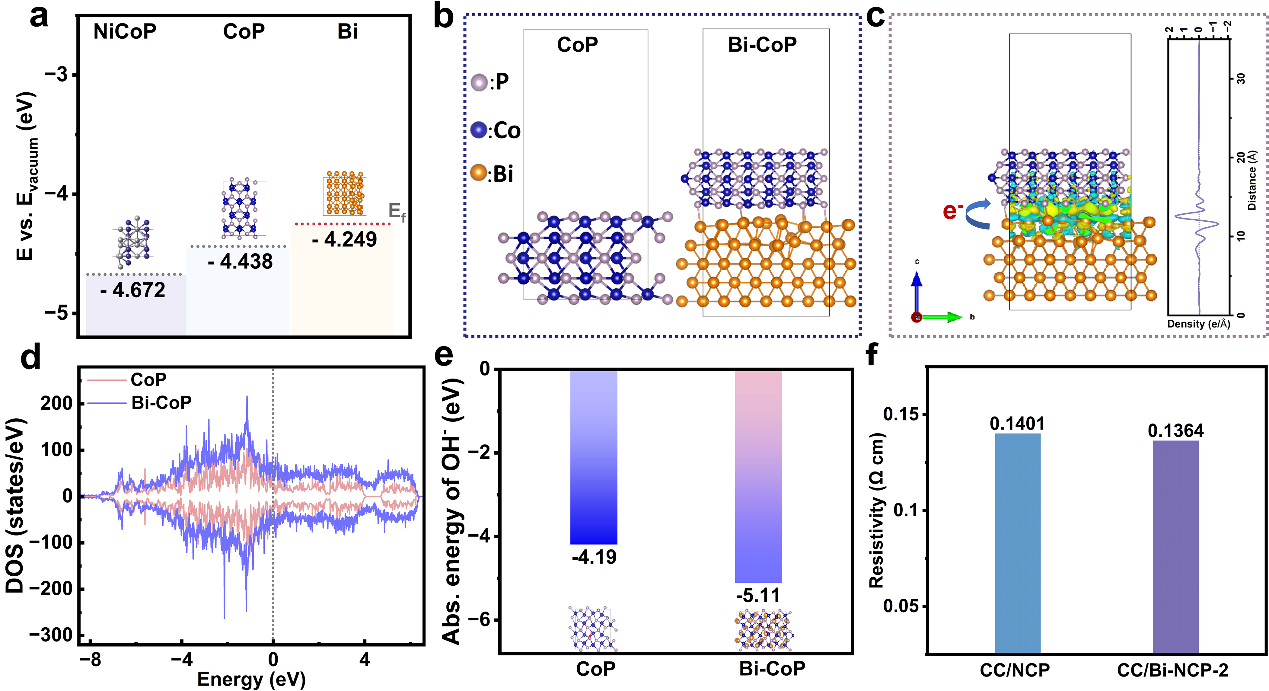
Combined experimental characterizations and density functional theory (DFT) calculations verify that an intrinsic built-in electric field (IEF) favorable for alkaline energy storage forms at the Bi/NiCoP heterointerface. The constructed heterostructure accelerates charge transfer and redistribution, as well as the adsorption and migration of OH⁻ anions. The underlying mechanism through which hierarchical heterostructures enhance overall electrode specific capacity and rate performance is systematically elucidated. The proposed dual-functional Bi interlayer strategy simultaneously manipulates two critical factors: the electrodeposition kinetics of outer active layers and the intrinsic electrochemical performance of heterostructures. Moreover, this strategy possesses good universality. Such a design philosophy provides guidance for the future development of hierarchical composite electrodes applied in advanced electrochemical energy storage devices.
Figure 2. (a) Schematic Fermi level alignment of NiCoP, CoP and Bi. (b) Atomic structural model of CoP and Bi-CoP heterostructure. (c) Charge density difference at the Bi-CoP heterointerface (yellow regions denote charge accumulation; green regions represent charge depletion). (d) Total density of states (TDOS) of CoP and Bi-CoP. (e) Adsorption energy of OH species on CoP and Bi-CoP. (f) Resistivity curves of CC/NCP and CC/Bi-NCP-2.
Xu Jian, a 2020 doctoral student majoring in Materials Physics and Chemistry at the College of Materials Science and Engineering, Jilin University, and Gong Xiliang, a 2019 undergraduate (now a PhD candidate at the University of Maryland), are the co-first authors of this paper. The corresponding authors are Professor Tian Hongwei and Professor Zheng Weitao from the Low-Dimensional Materials Research Group, College of Materials Science and Engineering, Jilin University. This research was supported by the Natural Science Foundation of Jilin Province and the Open Research Fund of the Key Laboratory of Advanced Energy Materials Chemistry (Ministry of Education), Nankai University.