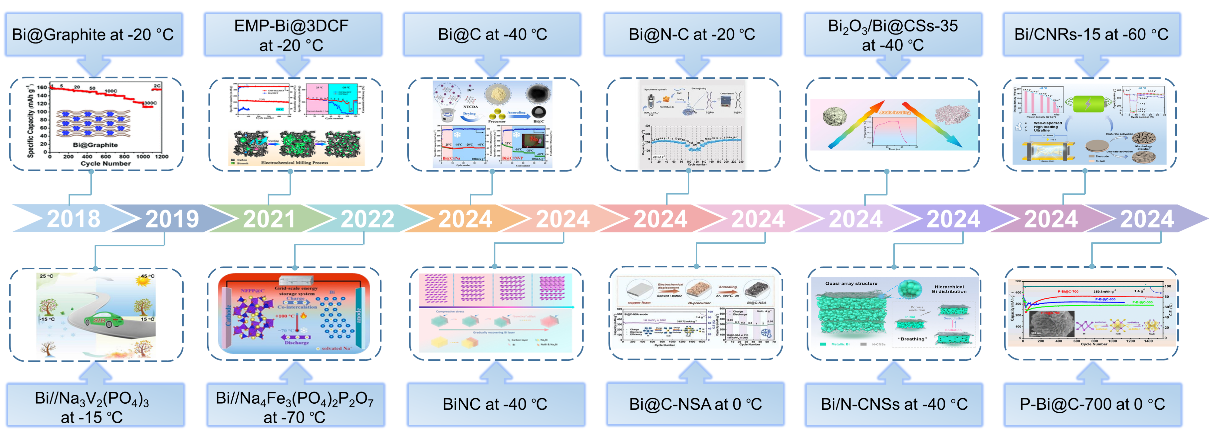
Recently, the research team led by Professors Jiang Qing and Yang Chuncheng from the College of Materials Science and Engineering, Jilin University published a comprehensive review systematically summarizing the research progress, existing challenges and future development directions of bismuth-based anodes toward high-performance low-temperature fast-charging sodium-ion batteries. This work provides important theoretical guidance and design strategies for developing next-generation energy storage devices applicable to extreme environments. The review article, entitled Bi: A rising star for low-temperature fast-charging sodium-ion batteries, was published online on June 20, 2025 in Materials Science and Engineering: R: Reports.
With the surging demand for energy storage, the popularization of electric vehicles in cold regions, as well as special applications such as polar and deep-sea exploration, impose stringent requirements on the low-temperature performance of batteries. Compared with lithium-ion batteries, sodium-ion batteries exhibit great potential for wide-temperature operation due to inherent merits including smaller Stokes radius of Na⁺ and lower desolvation energy. Among various anode candidates, bismuth-based materials stand out by virtue of abundant natural reserves, environmental benignity, moderate reaction potential and high theoretical specific capacity. More importantly, their unique advantages for low-temperature fast-charging applications originate from the highly conductive intermediate phases generated during alloying reactions, rapid pseudocapacitance-dominated charge storage kinetics, and electrolyte-induced structural self-optimization in ether-based electrolytes.
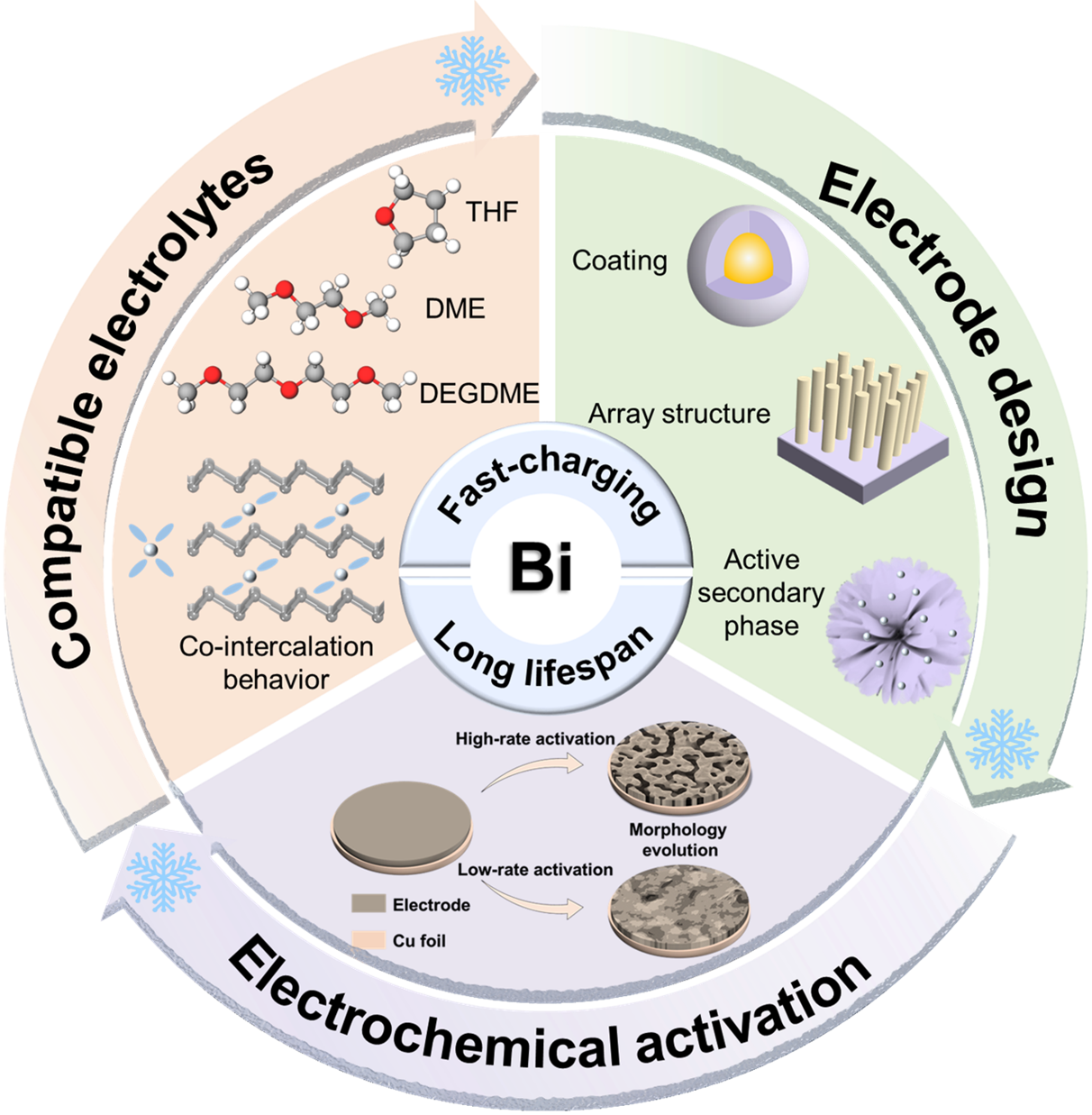
Nevertheless, severe obstacles still hinder the low-temperature deployment of Bi-based anodes, including sluggish solid-state ion diffusion, reduced ionic conductivity of electrolytes, slow desolvation kinetics of sodium ions, and critical volume expansion issues that urgently need to be addressed. This review proposes multiple strategies to boost the low-temperature fast-charging capability of bismuth anodes, covering electrolyte engineering, electrode structural design and electrochemical activation. Meanwhile, advanced characterization techniques combined with theoretical calculations are highlighted as powerful tools to unravel phase transitions, structural evolution and interfacial chemistry of Bi-based electrodes during cycling.
Furthermore, the review prospects the roadmap for translating lab-scale Bi-based materials to industrialization, and identifies core bottlenecks requiring prioritized breakthroughs: scalable controllable synthesis, performance optimization of full-cell systems, and establishment of standardized evaluation protocols under extreme operating conditions. The authors emphasize that integrating in-situ low-temperature characterizations with data-driven machine learning approaches to deeply investigate interfacial ion transport, phase transformation and degradation mechanisms at ultralow temperatures will accelerate the rational design and high-throughput screening of high-performance electrolytes and electrode materials, thereby advancing the large-scale utilization of sodium-ion batteries under harsh environmental conditions.
Bai Jie, a doctoral candidate of Jilin University, is the first author of this review. Researcher Zhang Hong, Professor Yang Chuncheng and Professor Jiang Qing from Jilin University serve as the corresponding authors. This research was supported by the Science and Technology Development Program of Jilin Province and the National Natural Science Foundation of China.