Recently, the teams led by Professors Jiang Qing and Wang Tonghui from the College of Materials Science and Engineering, Jilin University, collaborated with the research group of Professor Ren Guangyu from City University of Hong Kong. Combining experimental characterizations with theoretical calculations, they made groundbreaking progress in toughening hole-selective self-assembled monolayers (SAMs) and improving the durability of inverted perovskite solar cells. The research paper, titled Toughened self-assembled monolayers for durable perovskite solar cells, was published online on September 17, 2025 in Nature.
Molecular thin films spontaneously formed on substrate surfaces via noncovalent or covalent intermolecular interactions possess unique structural and functional merits, making them critical materials to address core challenges of perovskite solar cells (PSCs), including interfacial defects and energy level mismatch. Nevertheless, the intrinsic instability and uneven surface coverage of SAMs degrade the long-term operational stability of devices. In particular, abundant free volume surrounding flexible linkers within SAM structures readily induces structural deformation, severely impairing PSC durability.
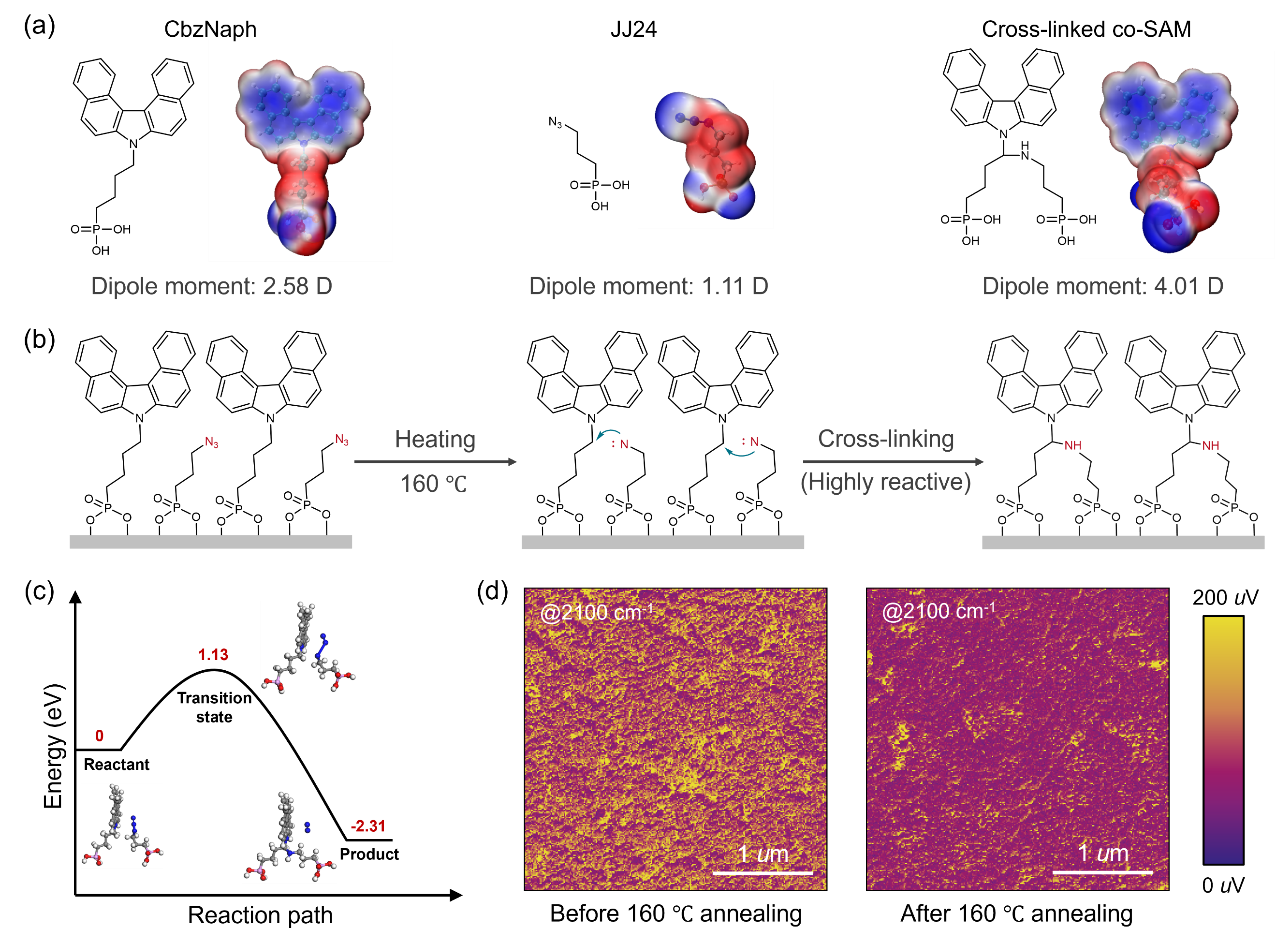
To tackle the instability, inhomogeneous coverage and stress-induced conformational variation of SAMs, this work innovatively introduced crosslinkable azide-functionalized guest molecule JJ24 to form crosslinked co-SAMs with host CbzNaph. This strategy strengthens conformational stability of SAMs, suppresses defect generation, and optimizes interfacial energy level alignment as well as charge extraction. The linear propyl linker of JJ24 is shorter than the butyl linker of host CbzNaph, which enables JJ24 to fill interstitial voids and strengthen van der Waals interactions among SAM molecules (Figure 1a, 1b). The crosslinking reaction features a favorable Gibbs free energy of −2.31 eV and a moderate energy barrier of 1.13 eV (Figure 1c). Annealing the co-SAMs at 160 °C activates azide groups to drive complete crosslinking between CbzNaph and JJ24 (Figure 1d). Hydrogen bonding between phosphate groups and van der Waals forces among alkyl linkers introduced by JJ24 inhibit micelle formation and guarantee uniform dispersion of SAMs.
Figure 1. Molecular design and crosslinking mechanism of toughened self-assembled monolayers.
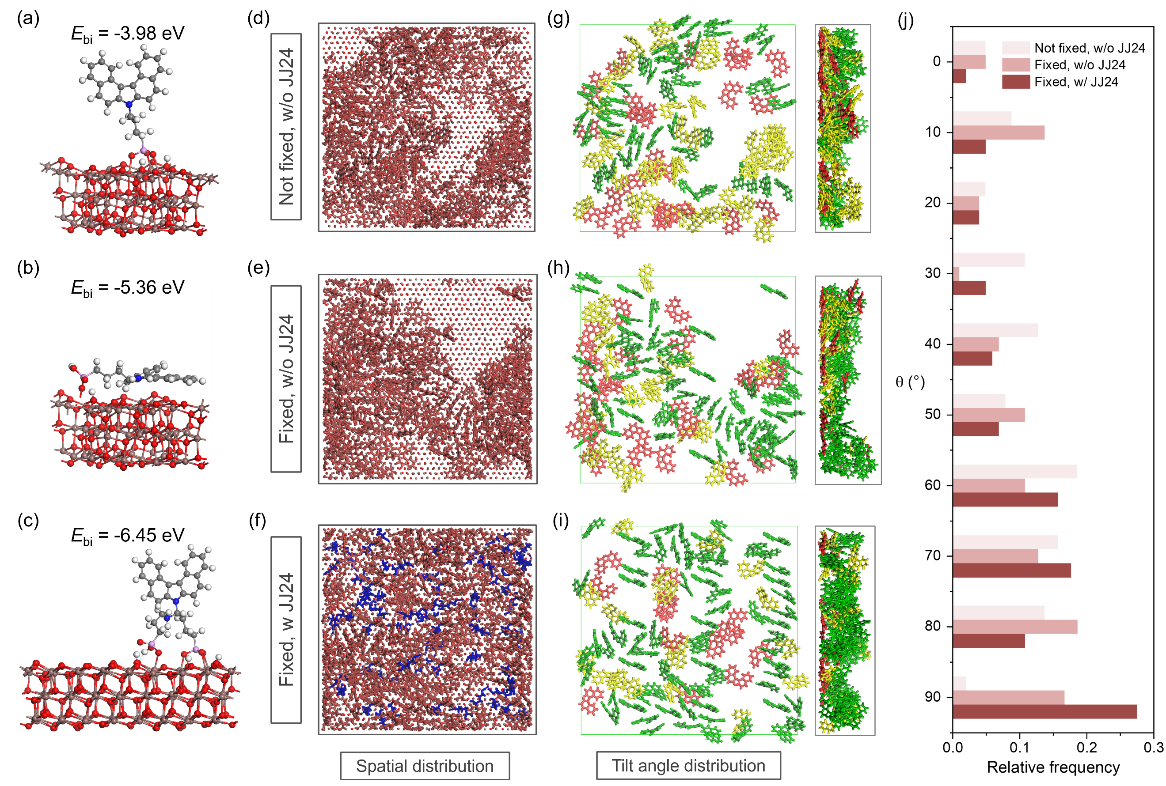
Theoretical calculations reveal that pristine CbzNaph molecules tend to lie flat on ITO substrates (Figure 2b) rather than stand upright (Figure 2a), driven by flexible alkyl chains and strong binding affinity with ITO. In contrast, crosslinked co-SAMs optimize molecular orientation and adopt an upright configuration on ITO (Figure 2c). Moreover, the incorporation of JJ24 introduces extra anchoring sites and drastically enhances adhesion between SAMs and the substrate. Molecular dynamics simulations demonstrate that pure CbzNaph tends to form incomplete surface coverage (Figure 2d–f). After introducing JJ24, crosslinked co-SAMs exhibit enlarged molecular tilt angles (Figure 2g–j) and drastically improved uniformity of molecular distribution. This effectively prevents direct contact between perovskite and ITO, lowering risks of charge recombination and perovskite degradation.
Figure 2. Molecular dynamics simulations of host-guest self-assembled monolayers.
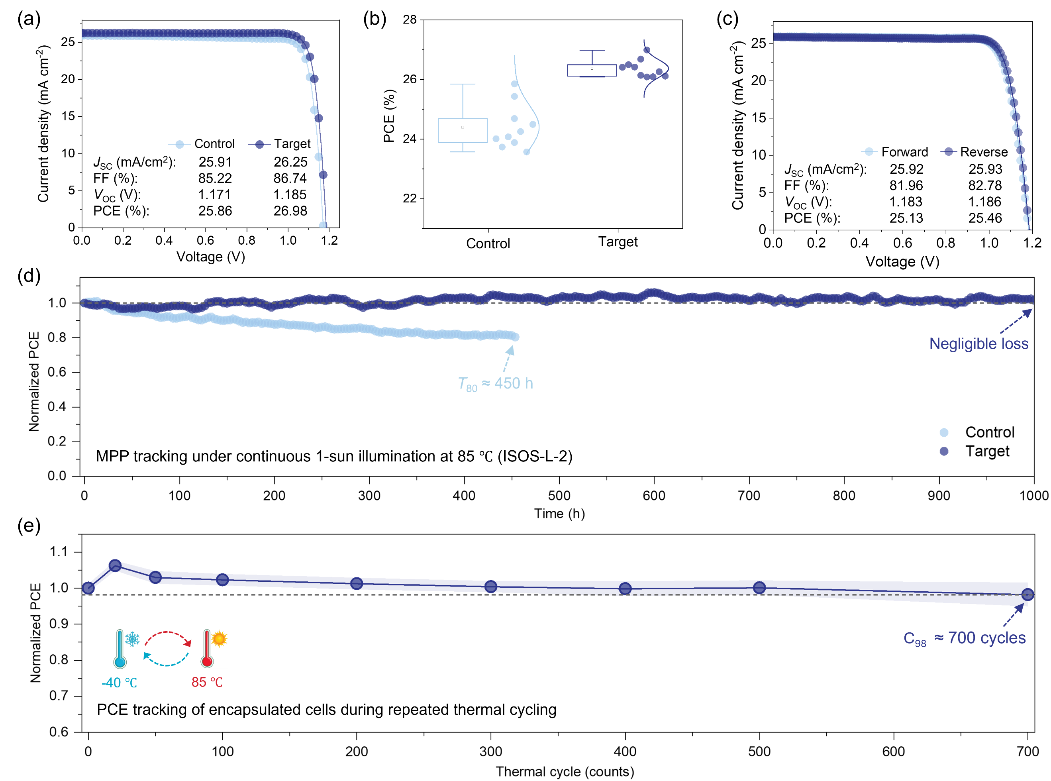
The optimized device fabricated with crosslinked co-SAMs achieves a power conversion efficiency (PCE) of 26.98%, with a certified PCE of 26.92% (Figure 3a–c). After continuous operation at the maximum power point for 1000 hours, nearly no PCE attenuation is observed (Figure 3d). The device exhibits outstanding stability during repeated thermal cycling under dark ambient conditions. The encapsulated device retains 98.2% of its initial PCE after 700 thermal cycles.
Figure 3. Photovoltaic performance of PSCs.
Aging tests on peeled perovskite films show that perovskite surfaces modified with crosslinked co-SAMs largely preserve their original morphology (Figure 4a), with negligible surface variation after rinsing with N,N-dimethylformamide (Figure 4b). Crosslinked co-SAMs deliver higher molecular rigidity and denser spatial packing, minimizing exposed substrate areas and suppressing interfacial nonradiative recombination (Figure 4c, 4d). This overcomes the key bottleneck that has long restricted device efficiency and stability.
Figure 4. Mechanism study on enhanced PSC stability enabled by toughened SAMs.
This study clarifies that the instability of SAM-based devices originates from structural degradation of SAMs during thermal aging, which exposes bare substrate surfaces. A novel crosslinkable co-SAM strategy accompanied by atomic-scale mechanistic interpretation is proposed, which improves molecular dispersity and conformational stability of SAM molecules to break the efficiency ceiling of perovskite solar cells. Furthermore, this approach can be extended to other SAM-based devices built on high-roughness substrates, bearing great significance for advancing their commercialization.
Dr. Jiang Wenlin and Dr. Qu Geping from City University of Hong Kong are co-first authors of this paper. Corresponding authors include Professor Ren Guangyu (City University of Hong Kong), Associate Researcher Zhang Jie (Shenzhen Institutes of Advanced Technology, Chinese Academy of Sciences), Professor Jiang Qing (Jilin University), and Professor Wu Shengfan (Lingnan University, Hong Kong). The research work conducted at Jilin University was supported by the National Key Research and Development Program of China and the National Natural Science Foundation of China.