Prof. Zhao Lijun’s Team Publishes Research Paper in Advanced Materials
Recently, the research team led by Professor Zhao Lijun from the College of Materials Science and Engineering, Jilin University has achieved a major breakthrough in the research of integrated thick-film electrodes for supercapacitors, and successfully fabricated all-pseudocapacitive film-based supercapacitors. The relevant research results, titled Magnetically Induced Ordered Structure-Assisted Defect Engineering Strategy for High-Performance All-Pseudocapacitive Film Supercapacitors, were published on May 6, 2026 in Advanced Materials, a top journal in materials science.
Supercapacitors possess broad application prospects in energy storage systems owing to their high power density, ultralong cycle lifespan and outstanding charge-discharge rate capability. Film-based supercapacitors integrate flexibility and lightweight merits, making them a research hotspot in the field of flexible energy storage. Nevertheless, electrodes of conventional film-based supercapacitors operate mainly via the electric double-layer capacitance (EDLC) mechanism, resulting in low specific capacity and an areal energy density generally below 0.2 mWh cm⁻², which fails to satisfy the dual requirements of high energy density and high power density. The core to boosting the energy density of film supercapacitors lies in breaking the capacity bottleneck of EDLC materials. Pseudocapacitive materials (e.g., transition metal compounds) realize charge storage through rapid and reversible surface redox reactions, whose specific capacitance can reach 5–10 times that of electric double-layer materials. Accordingly, developing high-capacity pseudocapacitive film electrodes serves as an effective route to elevate the device energy density.
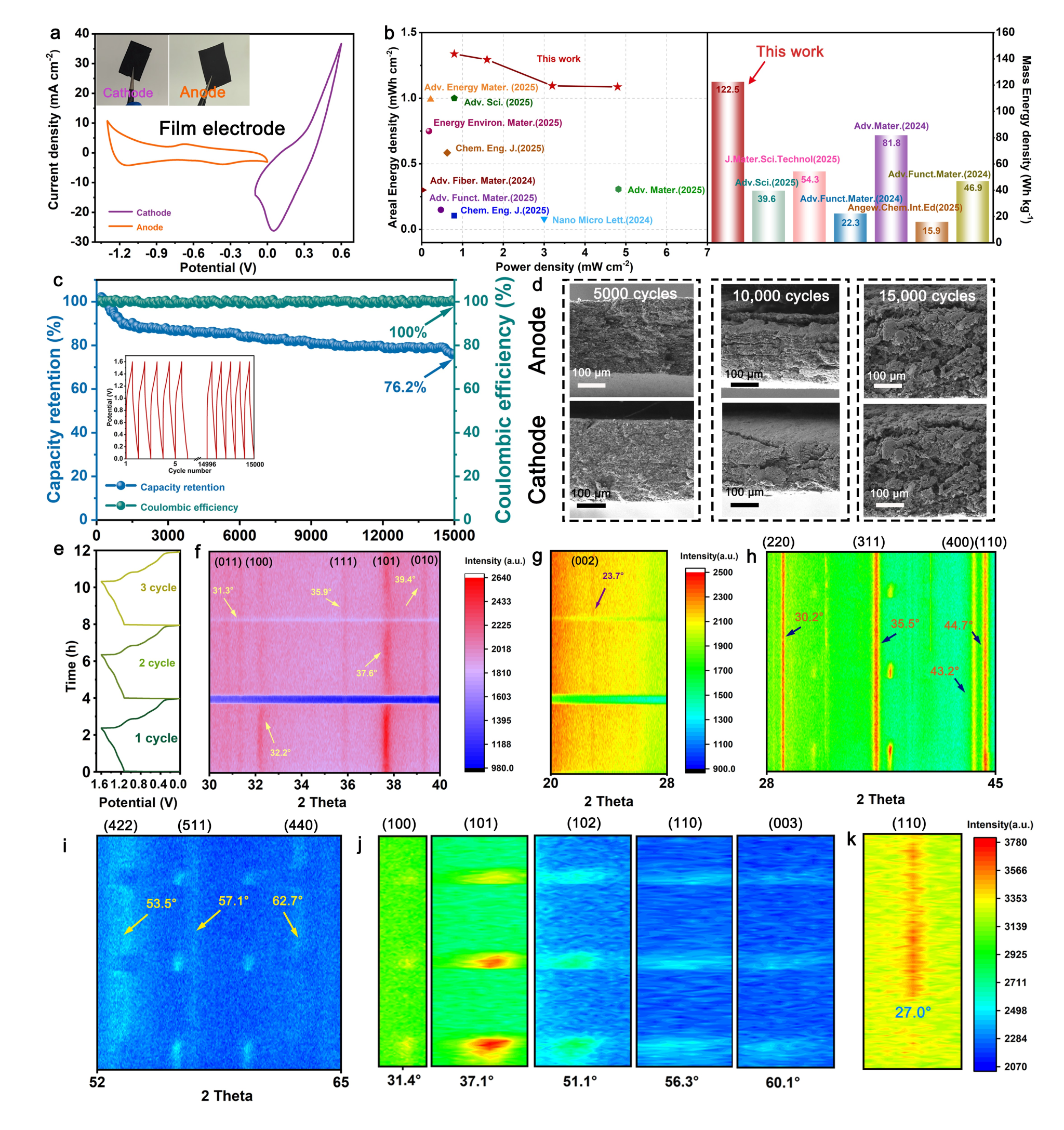
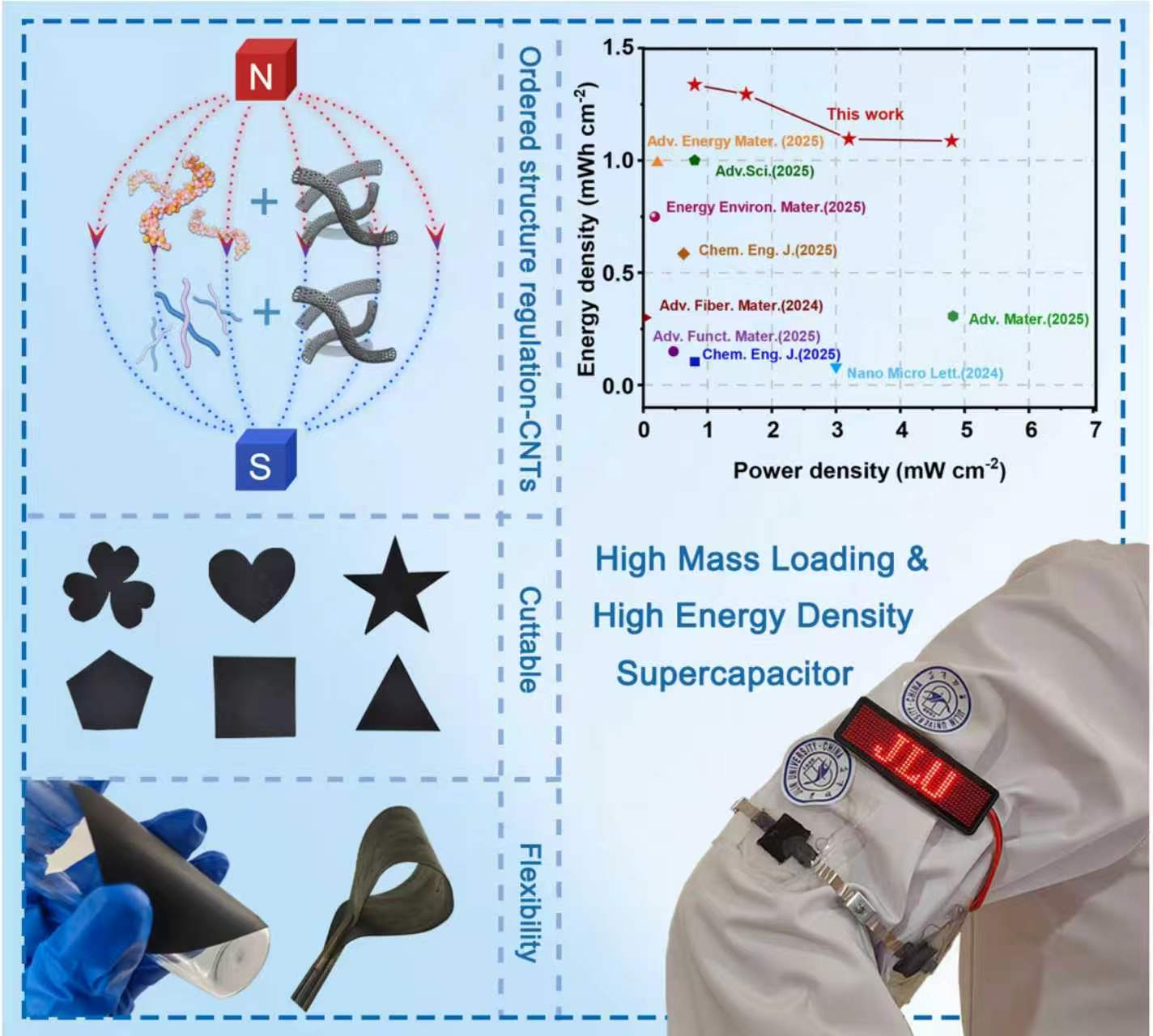
In this work, carbon-based materials were composited with transition metal compounds. Carbon-based materials can self-assemble into continuous flexible films via π–π stacking and exhibit excellent film-forming performance; by contrast, transition metal compounds are rigid crystalline materials plagued by poor flexibility, severe agglomeration and the inability to self-assemble into standalone films. The composite integrates the superior specific capacitance of transition metal compounds and the favorable film-forming property of carbon-based substrates, endowing the electrode with both remarkable electrochemical performance and robust mechanical stability. Moreover, lattice distortion and vacancy defects are introduced via structural modulation to further optimize the comprehensive performance of pseudocapacitive film electrodes. The asymmetric all-pseudocapacitive film supercapacitor developed in this paper provides novel insights and critical experimental support for overcoming the energy density limitation of film supercapacitors.
Pan Xinbo, a doctoral candidate at Jilin University, is the first author of this paper, and Professor Zhao Lijun from Jilin University is the corresponding author. This research was financially supported by the Science and Technology Development Program of Jilin Province.