Recently, the research teams led by Professor Cui Xiaoqiang from the College of Materials Science and Engineering and Professor Zhang Lei from the College of Chemistry, Jilin University, have achieved a crucial breakthrough in the field of photocatalytic CO₂ reduction. By precisely constructing a novel "nano-on-micro" heterostructure, the research group successfully addressed two critical bottlenecks: low kinetic efficiency of photogenerated charge carriers and poor accessibility of active sites, which drastically boosted the photocatalytic conversion performance of CO₂ to CO. The corresponding research paper, entitled Nano-on-Micro BiOCl₀.₆Br₀.₄/Zn₃In₂S₆ Heterostructure with Prolonged Charge Separation and Exposed Bi Active Sites for Efficient CO₂ Photoreduction, was published on January 16, 2026, in Nano Letters, a top journal in nanomaterials.
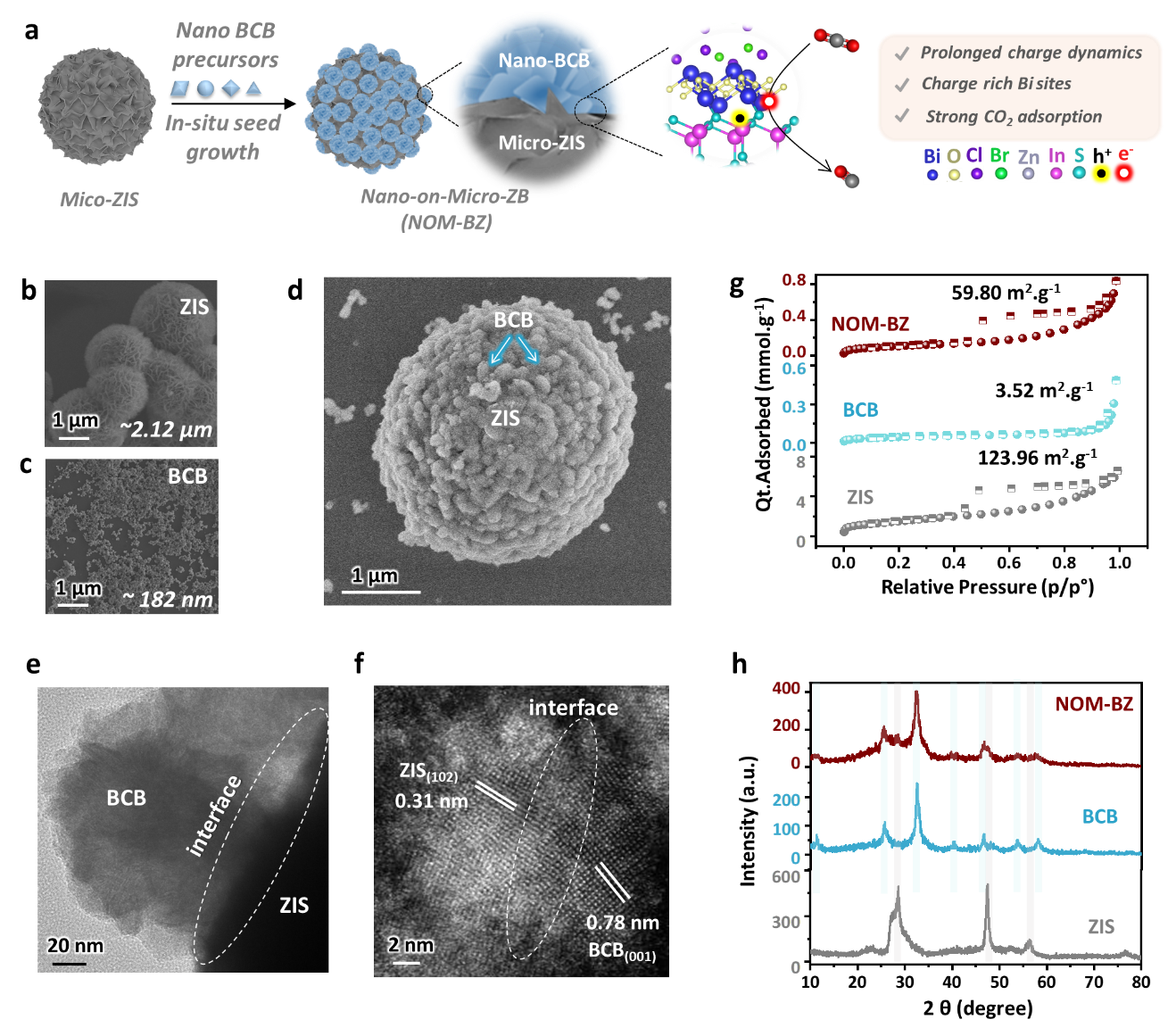
Converting CO₂ into high-value chemical fuels using solar energy represents an ideal strategy to advance sustainable development. Nevertheless, rapid recombination of photogenerated charge carriers and insufficient surface/interface active sites remain core obstacles limiting catalytic efficiency. To overcome these challenges, Professors Cui Xiaoqiang and Zhang Lei designed a distinctive "nano-on-micro" heterostructure (denoted NOM-BZ). Via an in-situ seed-mediated growth method, nanosized bismuth oxyhalide (BiOCl₀.₆Br₀.₄) was accurately immobilized within the cavities of microsized Zn₃In₂S₆, forming tightly bonded heterointerfaces.
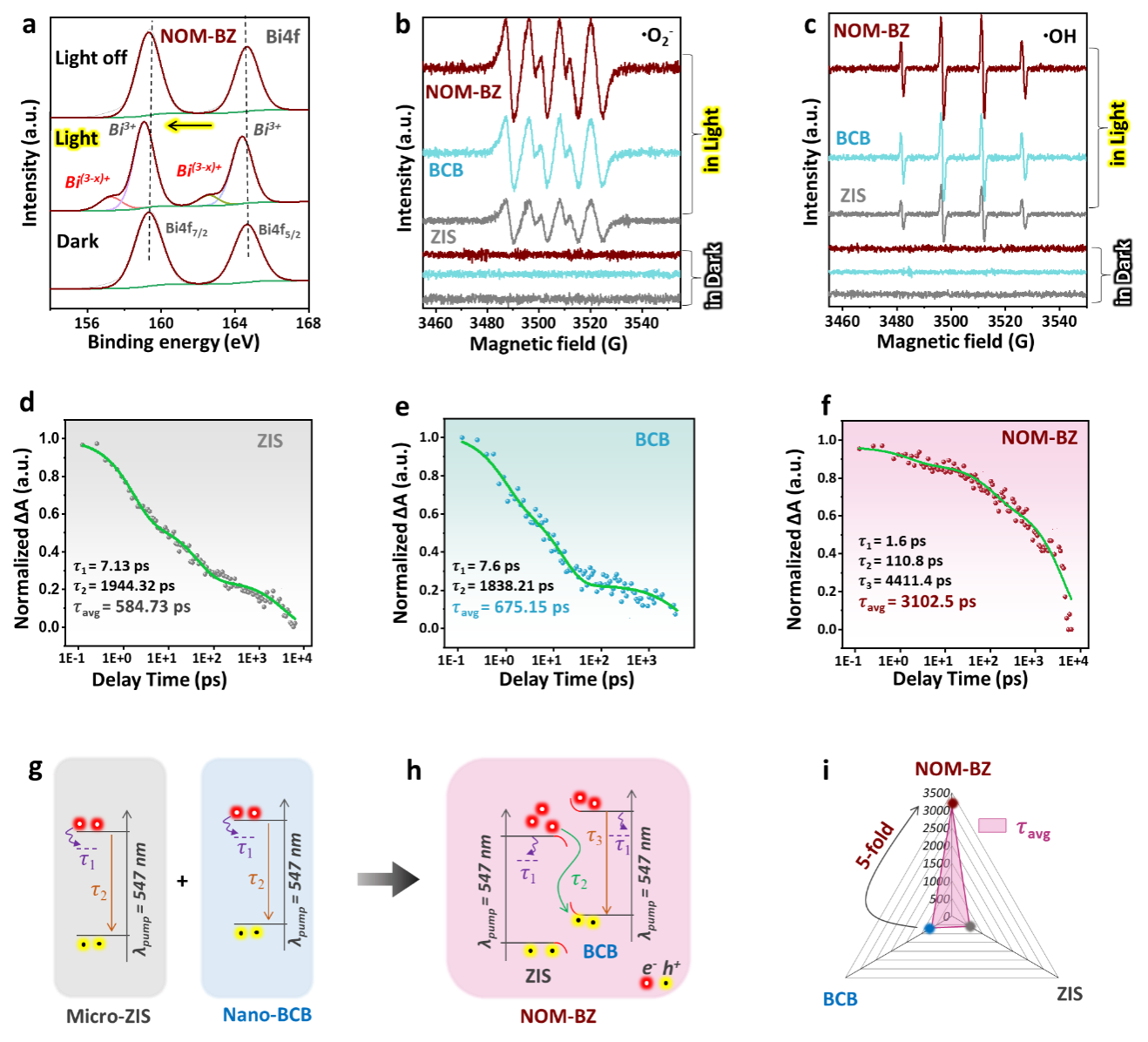
The as-fabricated NOM-BZ heterostructure delivers multiple synergistic merits. First, femtosecond transient absorption spectroscopy (fs-TA) characterizations demonstrate that this architecture remarkably extends the average lifetime of photogenerated charges to 3102 picoseconds, five times that of pristine counterparts, which effectively suppresses charge recombination and facilitates efficient charge separation. Second, in-situ X-ray photoelectron spectroscopy (XPS) and electron paramagnetic resonance (EPR) measurements verify that abundant electron-rich Bi active sites (Bi^(3−x)+ species) are dynamically generated at the heterointerfaces, serving as highly active centers for CO₂ reduction.
Benefiting from prolonged charge lifetime and fully exposed active sites, the NOM-BZ catalyst achieves a CO evolution rate of 45.9 μmol·g⁻¹·h⁻¹ with an ultrahigh CO selectivity of 96.3% in photocatalytic CO₂ reduction. No obvious performance decay is observed after a stability test over 30 hours. Theoretical calculations and in-situ diffuse reflectance infrared Fourier transform spectroscopy (DRIFTS) further reveal that the heterostructure greatly strengthens CO₂ adsorption and activation, while lowering the energy barrier for generating the key *COOH intermediate, thus accelerating the overall catalytic reaction pathway
Malik Zeeshan Shahid from the College of Materials Science and Engineering (Jilin University), Zhang Xinlei (Dalian Institute of Chemical Physics) and Su Qiwen are the co-first authors of this article. Professors Zhang Lei and Cui Xiaoqiang from Jilin University act as the corresponding authors. This research was supported by the National Natural Science Foundation of China, the National Key Research and Development Program of China, and the Science and Technology Development Program of Jilin Province.