Recently, the research group led by Researcher Gao Bo from the College of Materials Science and Engineering, Jilin University has made significant progress in the research of shear-coupled grain boundary migration. Leveraging large-scale molecular dynamics simulations driven by high-performance machine learning potentials, the team uncovered a distinctive shear-coupled migration mechanism co-determined by misorientation angles and atomic structures in [1 1 0] symmetric tilt grain boundaries of metallic platinum. The relevant research results, entitled Shear-Coupled Migration Governed by Misorientation Angles and Atomistic Structures in [1 1 0] Symmetric Tilt Grain Boundaries of Face-Centered-Cubic Pt, were published online on June 1, 2026, in Acta Materialia, a top journal in metallic materials.
Grain boundary behavior is a critical factor governing the mechanical properties of metallic materials. Subjected to external loading, grain boundaries undergo diverse dynamic processes, among which grain boundary migration is frequently coupled with shear sliding of adjacent grains. Revealing the atomic-scale mechanism of shear-coupled grain boundary migration is essential for a comprehensive understanding of grain boundary-mediated material deformation dynamics. Previous investigations into this phenomenon mostly focused on grain boundaries with relatively simple atomic structures, while systematic explorations of more complex grain boundaries remain scarce.
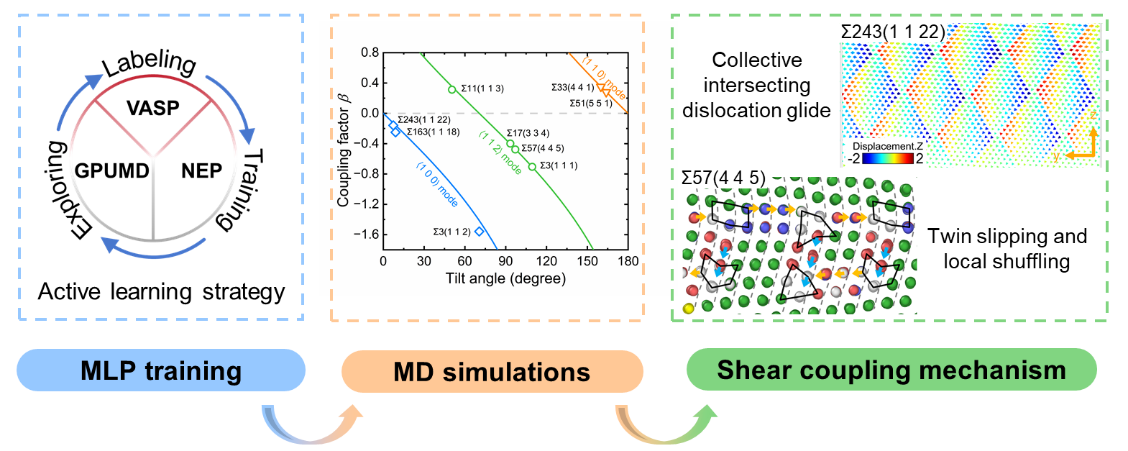
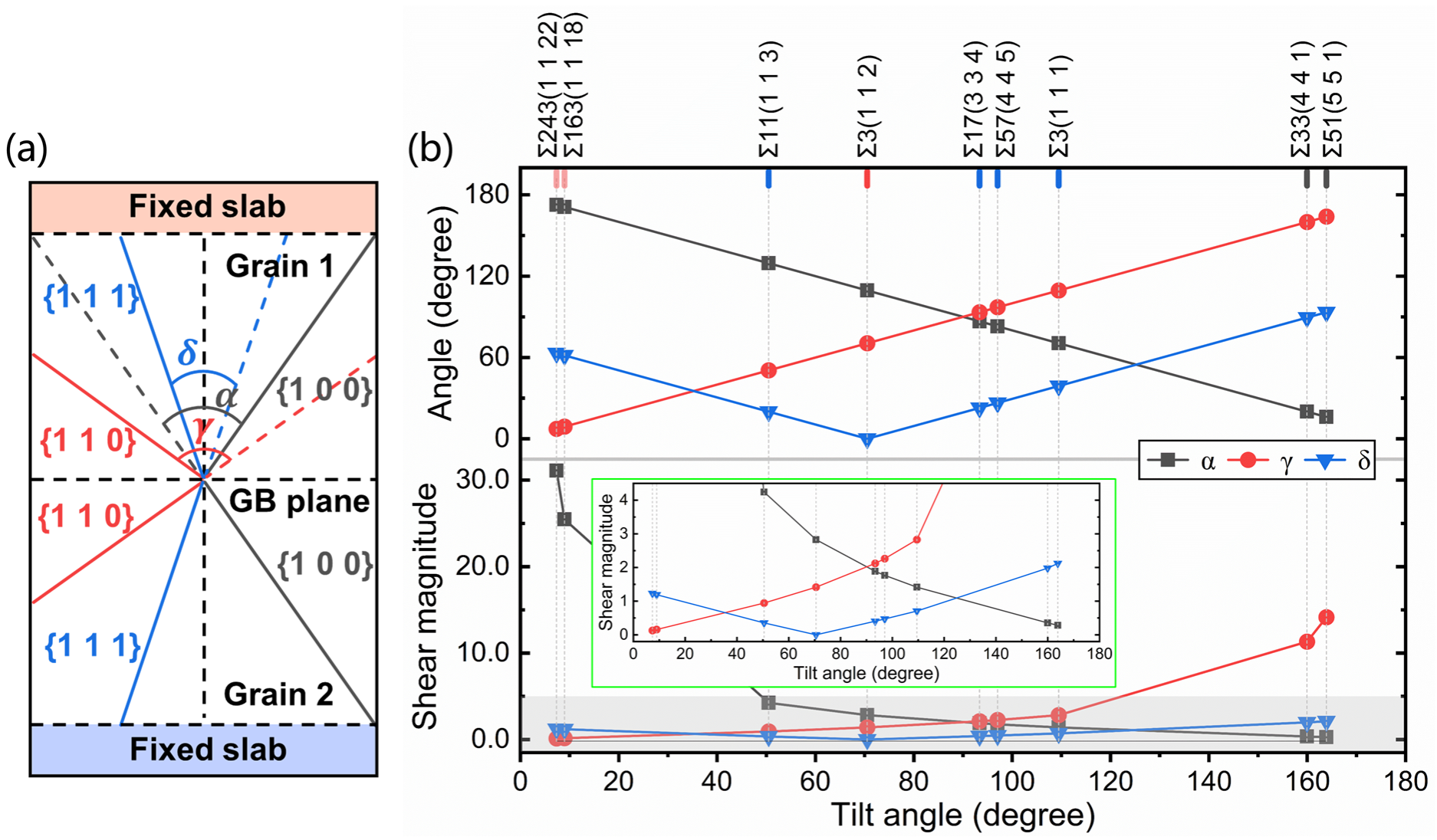
To address this gap, the team led by Researcher Gao Bo focused on the [1 1 0] symmetric tilt grain boundary system of face-centered cubic (FCC) metals. They constructed an efficient computational framework with accuracy comparable to first-principles calculations based on a neural evolution potential model, and thoroughly investigated shear-coupled grain boundary migration via large-scale molecular dynamics simulations. The study reveals that the migration of some low-angle grain boundaries is dominated by the cooperative motion of multiple dislocations. For certain high-angle grain boundaries, their migration is strongly governed by twin boundaries, which deviates from the previously proposed step dislocation nucleation mechanism. Furthermore, this work clarifies that misorientation angles exert a decisive influence on coupling modes.
The unique shear-coupled grain boundary mechanism discovered in this study provides new insights for an in-depth understanding of grain boundary deformation dynamics.
Figure 1. Twin-mediated local atomic rearrangement process within the Σ57(4 4 5) grain boundary.
Figure 2. Correlation between coupling modes and misorientation angles
Wang Zhenduo, a doctoral candidate at Jilin University, is the first author of this paper, and Researcher Gao Bo from Jilin University is the corresponding author. This research was supported by the National Natural Science Foundation of China, the Major Special Project for Advanced New Materials, and the Scientific Research Start-up Fund of Jilin University.