Recently, the research team led by Professors Jiang Qing and Yang Chuncheng from the College of Materials Science and Engineering, Jilin University proposed a strategy integrating "CoF₂ reservoir-driven F-mediated dynamic electronic regulation" and developed F-modified NiFe LDH/CoF₂ heterojunction electrocatalysts. The relevant research findings, titled F-mediated dynamic electronic regulation via CoF₂ reservoir enables high-valence Ni for enhanced oxygen evolution, were published on May 26, 2026, in Acta Materialia, a top-tier journal in the field of materials science.
To achieve sustainable development, an urgent transition from fossil fuels to clean energy carriers is required. Green hydrogen (H₂), produced via water electrolysis powered by renewable electricity, has emerged as a promising new clean energy source. Nevertheless, the sluggish kinetics of the anodic oxygen evolution reaction (OER) fundamentally limit improvements in the catalytic efficiency of water electrolysis. Nickel-iron layered double hydroxides (NiFe LDHs) stand out as high-performance non-precious metal OER electrocatalysts owing to their low cost, abundant natural reserves, and tunable structures. The catalytic activity of this material is strongly correlated with the oxidation of Ni²⁺ to high-valence Ni species during the reaction. However, deep oxidation of Ni remains difficult to achieve at present: beyond thermodynamic formation energy barriers, high-valence Ni species such as Ni³⁺/Ni⁴⁺ exhibit far lower thermodynamic stability than Ni²⁺. Accordingly, the rational design of OER electrocatalysts with high-valence Ni active sites carries great significance yet faces numerous bottlenecks.
Among diverse modification strategies, anion doping has attracted extensive research attention for its capacity to modulate the local charge distribution of active sites and optimize the electronic configuration of metal centers. Fluorine features high electronegativity and forms readily dissociable metal-fluorine (M–F) bonds, which induce surface reconstruction of electrocatalysts. Most existing studies treat fluorine merely as a fixed dopant or surface modifier. Under practical reaction conditions, however, fluorides partially dissolve into the electrolyte and re-anchor onto reconstructed (oxy)hydroxide phases via adsorption or re-coordination. To date, the dynamic participation mechanism of fluorine has not been systematically elucidated, and few studies have established an intrinsic correlation between fluorine dynamic evolution and the generation behavior of high-valence Ni.
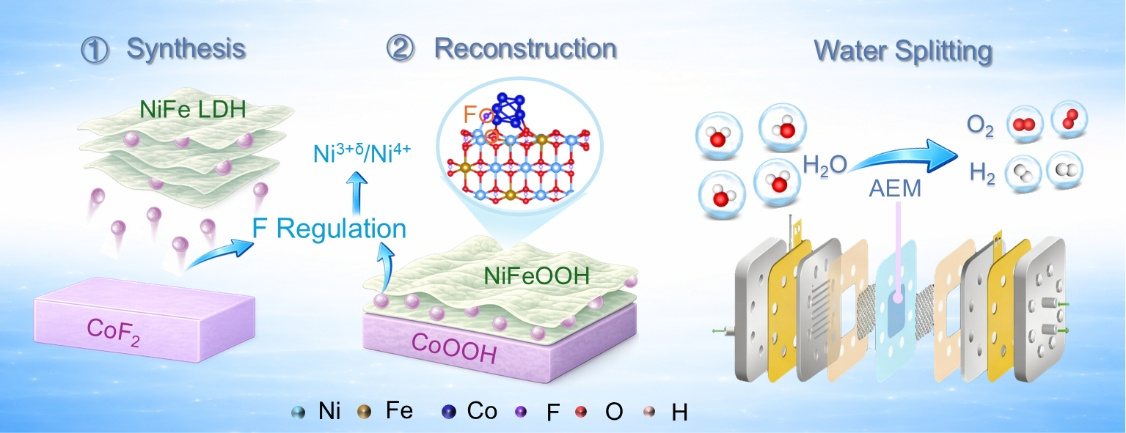
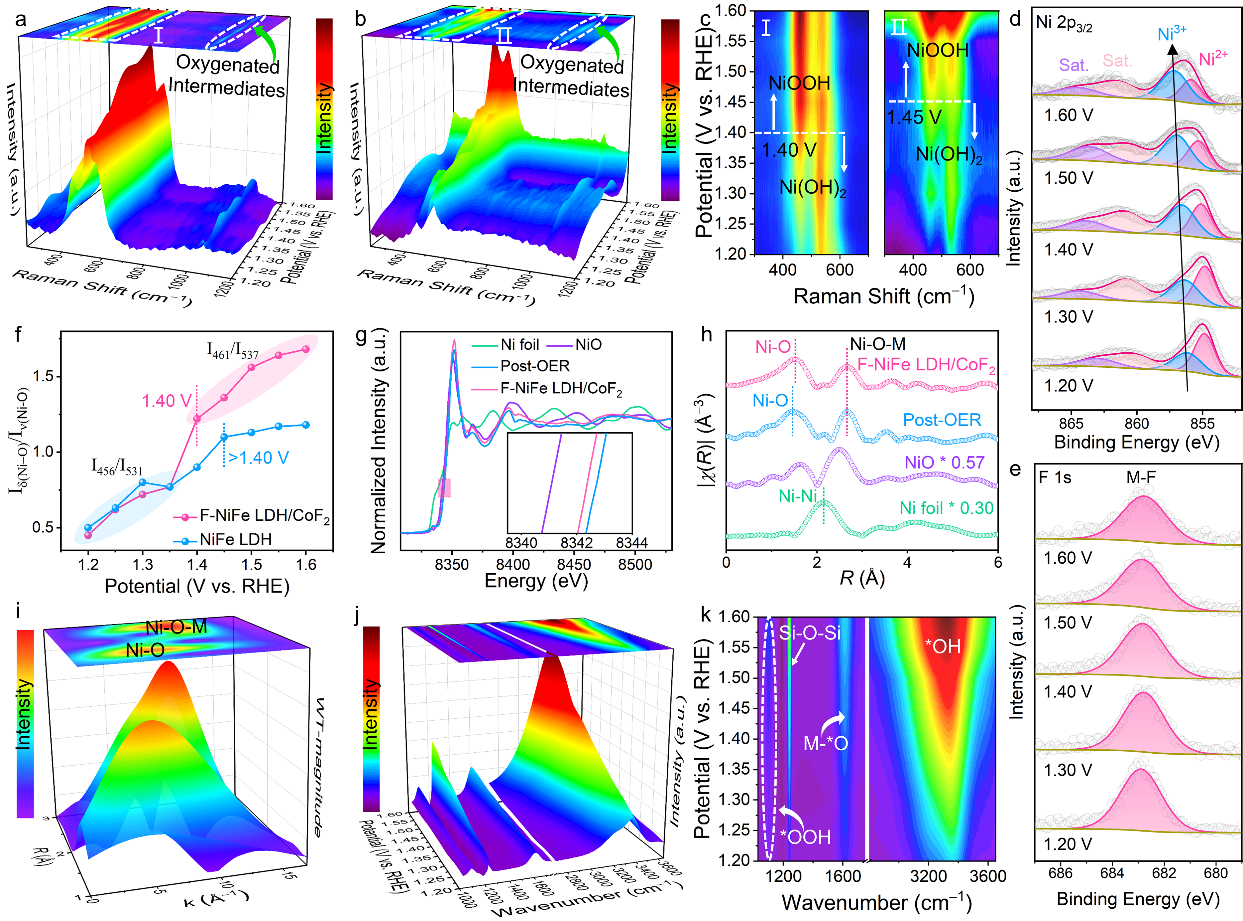
In this work, fluorine-modified hierarchical heterostructured nickel-iron layered double hydroxide/cobalt fluoride electrocatalysts (F-NiFe LDH/CoF₂) were rationally designed and fabricated. NiFe LDH serves as the primary active component, while CoF₂ acts as a fluoride ion reservoir. Dynamic modulation of the electronic structure of Ni sites by fluorine facilitates the formation of high-valence Ni³⁺ᵟ/Ni⁴⁺ species. During material synthesis, fluoride ions released from CoF₂ are doped into the NiFe LDH matrix. In the oxygen evolution process, CoF₂ undergoes in-situ reconstruction into CoOOH, with partial fluoride ions re-coordinating into the reconstructed oxyhydroxide framework. Theoretical calculations reveal that high-valence Ni active sites optimize intermediate adsorption and reduce deprotonation energy barriers. At a high current density of 1000 mA cm⁻², the as-prepared electrocatalyst delivers an OER overpotential of merely 290 mV and maintains stable operation for 1200 hours. An anion exchange membrane electrolyzer equipped with F-NiFe LDH/CoF₂ as the anode achieves a low cell voltage of 1.988 V at 1000 mA cm⁻² with long-term durability over 800 hours. This anion dynamic regulation strategy enabled by metal fluoride reservoirs offers a novel route to constructing high-valence active sites and can be extended to other transition-metal electrocatalysts and membrane electrolysis systems.
Li Hui, Hui Zhenxin and Xia Yongjin, doctoral candidates at Jilin University, are the co-first authors of this paper. Professors Yang Chuncheng and Jiang Qing from Jilin University serve as the corresponding authors. This research was financially supported by the National Natural Science Foundation of China and the Science and Technology Development Program of Jilin Province.