Recently, the research team led by Professors Gao Yipeng, Zha Min and Wang Huiyuan from the College of Materials Science and Engineering, Jilin University has achieved new advances in metal deformation and disclination theory. The research paper, entitled A Lie-algebra-based description of disclination densities and the quantification of partial disclinations in deformed polycrystalline metals, was published online on July 21, 2023 in Acta Materialia.
Crystal defects such as dislocations, disclinations and grain boundaries are crucial factors governing the mechanical properties of metallic materials. In accordance with topological defect theory in physics, dislocations and disclinations represent the two fundamental categories of topological defects in crystalline solids, corresponding to the breaking of translational symmetry and rotational symmetry, respectively. While the concept of dislocations and associated theories have been extensively applied to metallic material research, systematic investigations regarding how disclinations influence deformation behavior and mechanical performance of metals remain scarce. The primary bottleneck lies in the absence of rigorous mathematical formulations that accurately characterize the rotational nature of disclinations.
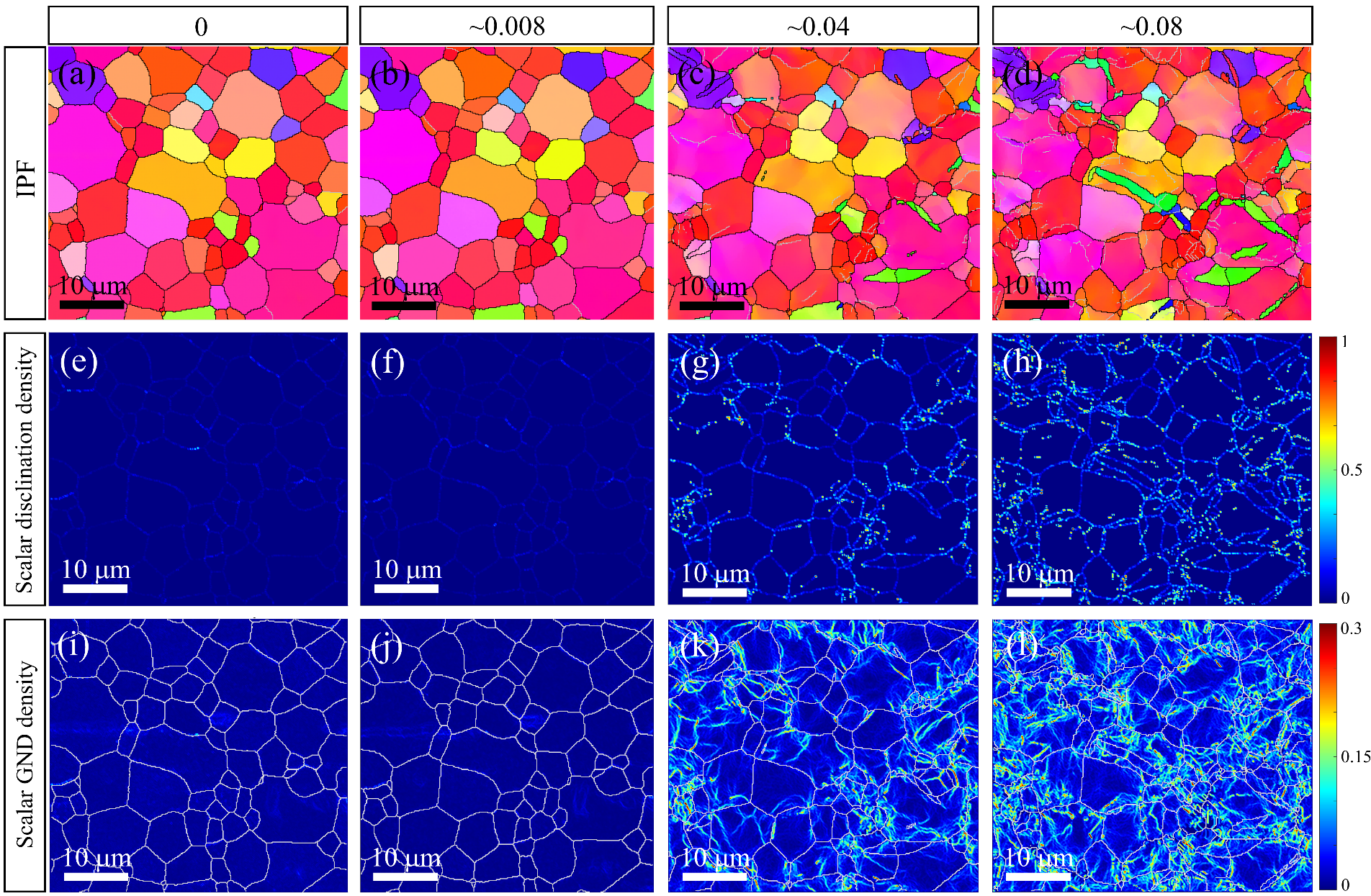
Figure 1. (a–d) Inverse pole figure (IPF) grain orientation maps; (e–h) total disclination density maps (unit: rad/μm²); (i–l) total geometrically necessary dislocation density maps (unit: rad/μm). Columns correspond to (a, e, i) annealed specimen, (b, f, j) specimen strained to 0.008, (c, g, k) specimen strained to 0.04, and (d, h, l) specimen strained to 0.08. In IPF maps, grain boundaries with misorientation angles ranging from 2° to 15° are plotted in gray, and high-angle grain boundaries above 15° are plotted in black.
To address this challenge, this work proposes a Lie-algebra-based framework to quantitatively characterize the rotational characteristic vectors of disclinations, enabling direct calculation of spatial disclination density distributions from electron backscatter diffraction (EBSD) datasets. Via quasi-in-situ EBSD characterizations, three dominant disclination generation mechanisms during plastic deformation of polycrystalline magnesium alloys are identified: dislocation-grain boundary interactions, dislocation rearrangement, and twin-boundary reactions. Within a unified mathematical framework, all three mechanisms can be interpreted as topological reactions between different crystal defects. This study not only delivers an innovative mathematical tool for exploring the interplay and mutual transformation of various crystal defects, but also establishes a novel perspective for unraveling how crystal defects regulate the mechanical properties of metals.
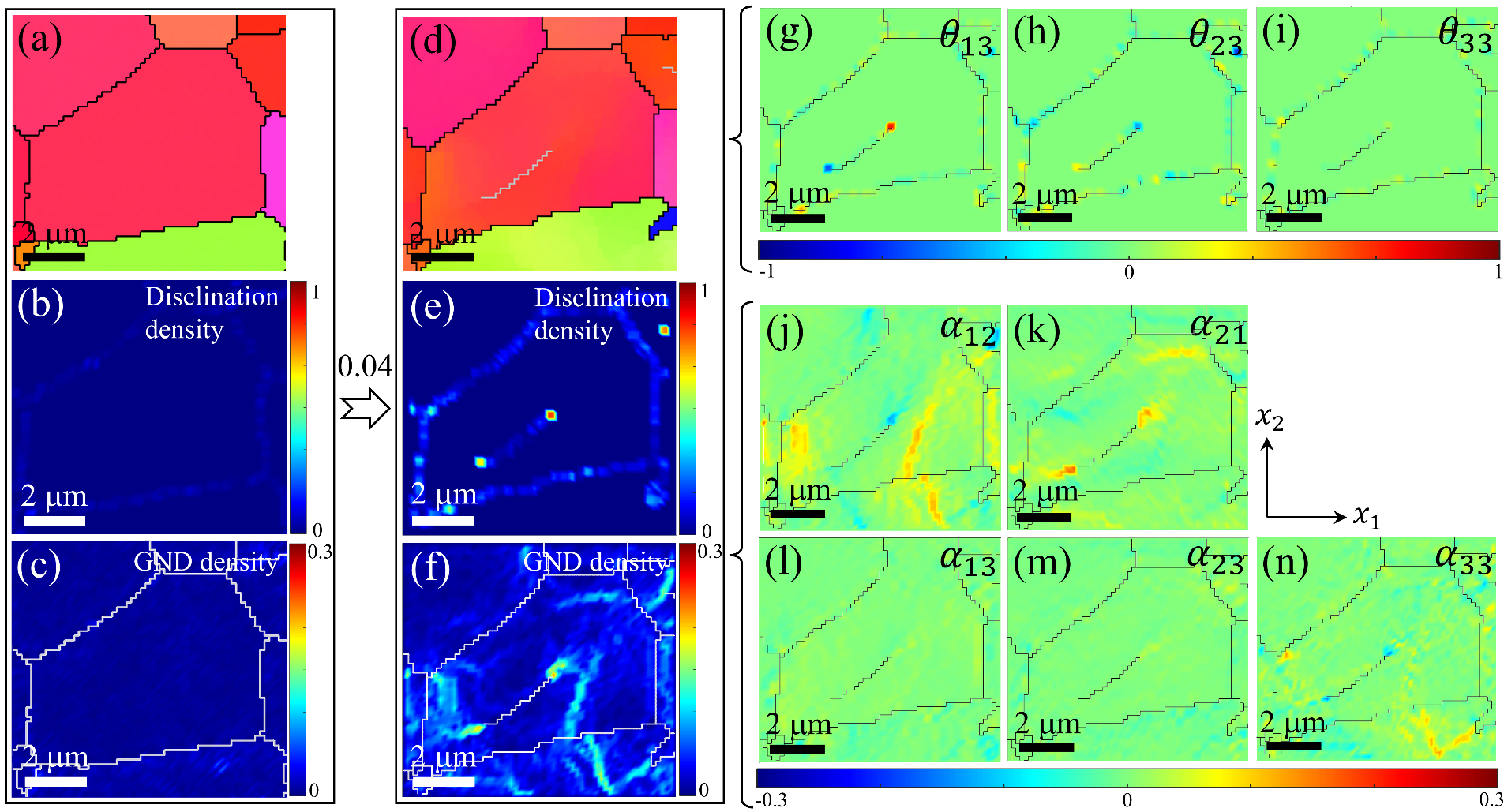
Figure 2. Partial disclinations generated via intracrystalline dislocation rearrangement: (a, d) IPF grain orientation maps of the annealed sample and the sample strained to 0.04; (b, e) corresponding total disclination density maps (unit: rad/μm²); (c, f) corresponding total dislocation density maps (unit: rad/μm). In IPF maps, grain boundaries with misorientation angles of 2°–15° are drawn in gray, and boundaries exceeding 15° are drawn in black. (g–i) Distributions of
disclination density components θ₁₃, θ₂₃ and θ₃₃ (unit: rad/μm²) for the specimen strained to 0.04; (j–n) Distributions of dislocation density components α₁₂, α₂₁, α₁₃, α₂₃ and α₃₃ (unit: rad/μm) for the specimen strained to 0.04.
Du Chunfeng, a doctoral student majoring in Materials Processing Engineering, is the first author of this paper. The corresponding authors are Professor Gao Yipeng and Professor Wang Huiyuan from the College of Materials Science and Engineering, Jilin University. This research was supported by General Programs and Key Programs of the National Natural Science Foundation of China.