Recently, the Low-Dimensional Materials Research Group from the College of Materials Science and Engineering, Jilin University has achieved new progress in the electrochemical energy storage applications of high-entropy oxides. The research paper entitled Dual-ion (de)intercalation into high-entropy perovskite oxides for aqueous alkaline battery-supercapacitor hybrid devices was published in Acta Materialia on September 15, 2023.
Benefiting from multi-element synergistic effects, high-entropy oxides deliver favorable specific capacity and outstanding cycling stability for low-power energy storage devices such as lithium-ion batteries. Nevertheless, their cycling performance falls far short of expectations when extended to high-power aqueous battery-supercapacitor hybrid (BSH) energy storage devices. In this work, high-entropy perovskite oxides are selected as electrode materials for BSH devices. Their electrochemical energy storage behaviors in alkaline aqueous electrolytes are systematically investigated to reveal the capacity fading mechanism upon repeated cycling. The conclusions provide guidance for designing high-stability high-entropy perovskite electrode materials and further advance the application of high-entropy oxides in high-performance BSH energy storage devices.
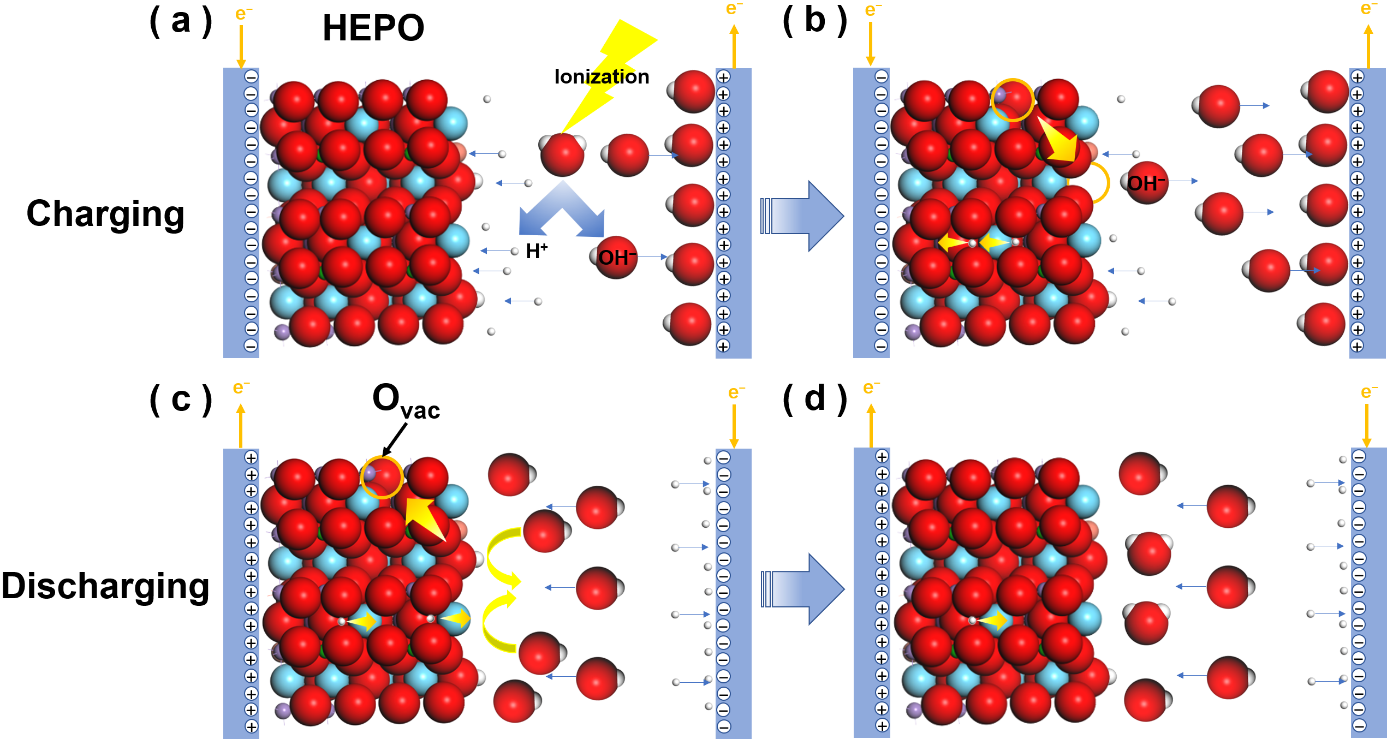
Ex-situ XRD, TEM and XPS characterizations clarify the electrochemical behavior of La₀.₇Bi₀.₃Mn₀.₄Fe₀.₃Cu₀.₃O₃ high-entropy perovskite oxides in alkaline aqueous electrolyte: oxygen anion extraction during charging facilitates hydrogen ion intercalation. However, severe lattice distortion inherent to high-entropy crystal structures restricts oxygen anion diffusion only to the (sub-)surface layers. During discharge, oxygen vacancies on the (sub-)surface are rapidly refilled by oxygen species from OH⁻, which hinders the deintercalation of hydrogen ions.
Figure 1. Schematic illustration of the dual-ion intercalation/deintercalation mechanism of high-entropy perovskite oxides during charge and discharge. Charging process: (a) water ionization and electrode surface hydroxylation; (b) oxygen anion extraction and hydrogen ion intercalation. Discharging process: (c) oxygen anion intercalation and hydrogen ion deintercalation; (d) extracted hydrogen ions react with surface hydroxyl groups to generate water that detaches from the electrode surface.
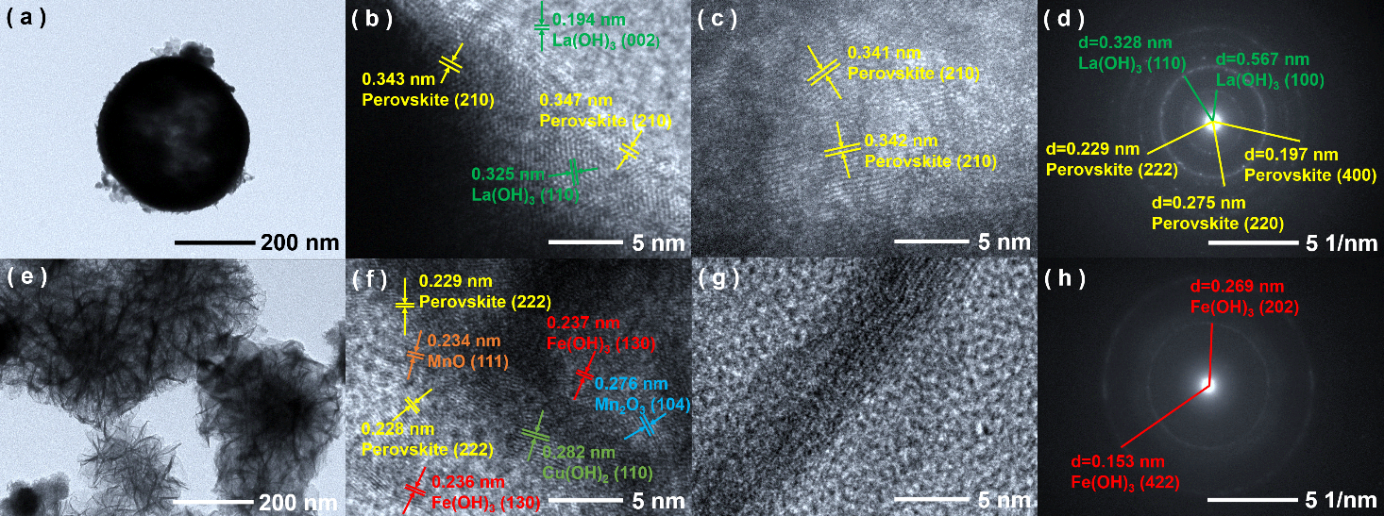
Based on the proposed dual-ion (de)intercalation mechanism, irreversible redox reactions during cycling generate residual stress inside the crystal lattice, triggering pulverization and exfoliation of electrode materials. Meanwhile, variations in surface coordination environments accompanying the evolution of surface oxygen species induce Jahn–Teller distortion of surface metal–oxygen octahedra, weakening the bonding force between surface octahedra and the bulk matrix and resulting in leaching of active metal cations. These electrochemical behaviors lead to the agglomeration of electrochemically inert La(OH)₃ on the material surface, which blocks ion transport between the electrolyte and internal active components and ultimately causes continuous specific capacity decay over long-term cycling. At the end of this paper, several electrode design strategies are put forward to improve the cycling stability of La₀.₇Bi₀.₃Mn₀.₄Fe₀.₃Cu₀.₃O₃ high-entropy perovskite oxides, including large-size A-site cation doping, introduction of electron-acceptor ions, and surface modification via composite hydroxides or other materials with large specific surface areas.
Figure 2. Morphological and phase characterizations of La₀.₇Bi₀.₃Mn₀.₄Fe₀.₃Cu₀.₃O₃ high-entropy perovskite oxides after 5000 charge/discharge cycles. Characterizations of materials remaining attached to electrodes: (a) TEM image; (b) HRTEM image of the (sub-)surface region; (c) HRTEM image of the bulk interior region; (d) SAED pattern. Characterizations of exfoliated substances detached from electrodes after cycling: (e) TEM image; (f) HRTEM image of crystalline domains; (g) HRTEM image of amorphous domains; (h) SAED pattern.
Nan Haoshan, a 2020-entry doctoral student from the College of Materials Science and Engineering, Jilin University, is the first author of this paper. The corresponding authors are Professor Tian Hongwei (College of Materials Science and Engineering, Jilin University) and Professor Hu Xiaoying (School of Science, Changchun University). This research was financially supported by the Excellent Science and Technology Innovation & Entrepreneurship Team Project of Jilin Province.