Recently, the Low-Dimensional Materials Research Group of the College of Materials Science and Engineering, Jilin University has made new advances in the electrocatalytic oxygen evolution reaction of pentlandite. The research paper titled Rapid Surface Reconstruction of Pentlandite by High-Spin State Iron for Efficient Oxygen Evolution Reaction has been published in Angewandte Chemie International Edition.
The oxygen evolution reaction (OER) is a critical reaction in energy conversion processes, yet its reaction kinetics are limited by the sluggish multi-step proton-coupled electron transfer process. During OER operation, electrochemical-induced surface reconstruction occurs on catalysts, and the newly reconstructed components are recognized as the actual active species. Recent studies have indicated that Fe serves as the active site for reconstruction reactions, and regulating its spin configuration is of great significance for developing high-activity catalysts. However, the factors affecting reconstruction reactions are complex and variable, and the modulation of metal ion spin states as well as their influence on the kinetics of OER reconstruction reactions remain unclear.
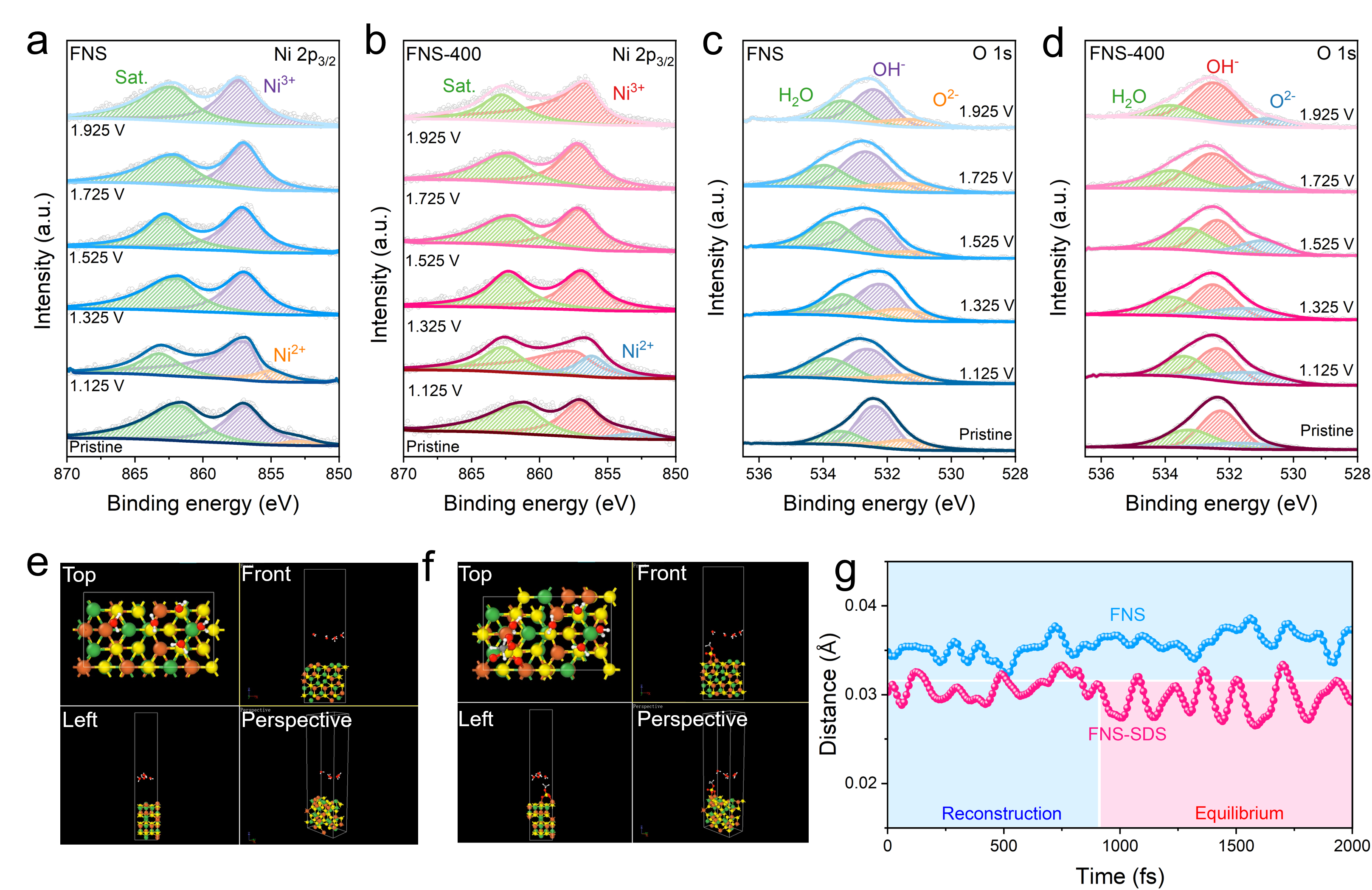
In this work, a surface electronic regulation strategy is adopted to realize the spin configuration transition of metal ions in Fe₅Ni₄S₈ (FNS). On this basis, in-situ XPS combined with a series of molecular dynamics simulations are used to explore the effects of spin state modulation on reconstruction kinetics and catalytic activity. The results reveal that high-spin Fe species in FNS-400 facilitate the accumulation of surface OH⁻, accelerate interfacial electron transfer, and boost the kinetic rate of surface reconstruction.
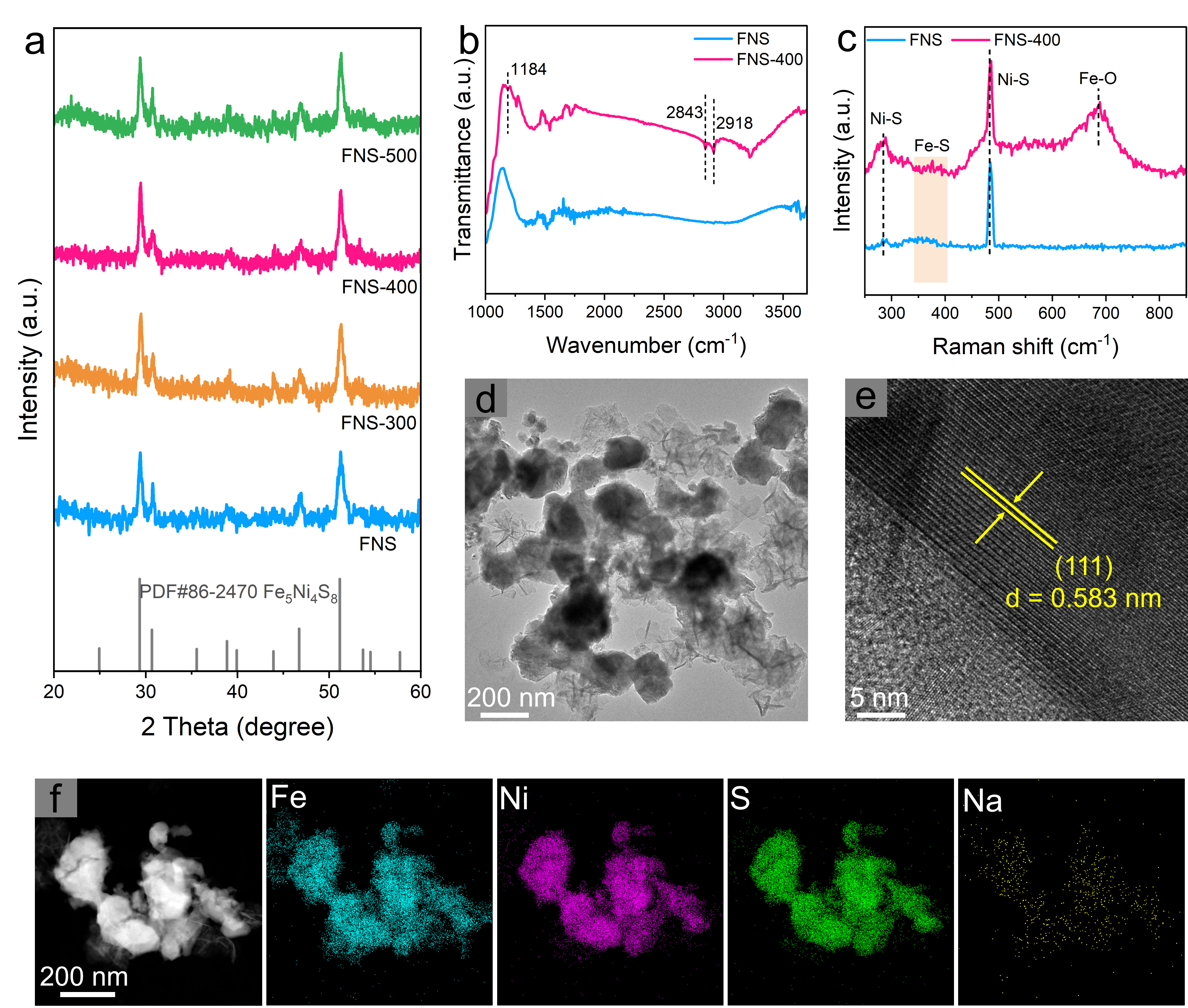
Figure 1. (a) XRD patterns of FNS and FNS-X; (b) FT-IR spectra of FNS and FNS-400; (c) Raman spectra of FNS and FNS-400; (d) TEM image of FNS-400; (e) HRTEM image of FNS-400; (f) HAADF-STEM image and corresponding elemental mapping of FNS-400.
Meanwhile, density functional theory (DFT) calculations demonstrate that high-spin Fe possesses a lower d-band center, which weakens the adsorption of oxygen-containing intermediates, promotes the rapid desorption of active intermediates, and thereby enhances OER catalytic activity. In 1 M KOH electrolyte, the optimized catalyst delivers an ultralow overpotential of 245 mV at 10 mA cm⁻² and exhibits outstanding long-term stability at a current density of 100 mA cm⁻². Focusing on the intrinsic correlation between reconstructive capacity and spin states, this work opens up a brand-new avenue for the design and application of FeNi-based catalysts.
Figure 2. In-situ Ni 2p₃/₂ XPS spectra at different potentials for (a) FNS and (b) FNS-400; In-situ O 1s XPS spectra at different potentials for (c) FNS and (d) FNS-400; Molecular dynamics simulation models of (e) FNS and (f) FNS-SDS in 1 M KOH solution; (g) Time-dependent distance between Fe central sites and OH⁻ particles obtained from molecular dynamics simulations of FNS and FNS-SDS.
Du Zhengyan and Meng Zeshuo, 2021 master students majoring in Materials Physics and Chemistry at the College of Materials Science and Engineering, Jilin University, are the co-first authors of this paper. The corresponding authors are Professor Tian Hongwei and Professor Yu Shansheng from the Low-Dimensional Materials Research Group, College of Materials Science and Engineering, Jilin University. This research was supported by the Key Research and Development Program of Jilin Provincial Department of Science and Technology.